




The global gambling market will cross $1 trillion in gross gaming revenue for the first time in 2030. Almost all of that growth is online. More countries are licensing iGaming for the first time. Operators are finding more markets worth entering legally. Every new jurisdiction is an entry point. Getting live is now the easy part.
The harder part shows up after you sign. An affiliate team takes its traffic in-house. A fund backs its first brand. An operator leaves a platform that stopped keeping up. In each case, the launch goes to plan. Then the first reports come in. The registration traffic is there, but it stalls before the deposit. The fix is a change to the funnel, and the platform takes weeks to ship it. By then the brand has spent its opening months underperforming, paying for traffic it cannot convert.
This guide covers how to start a white label casino in 2026, so you can avoid common pitfalls. From provider choice through go-live. Most of it is about what happens next. The first 90 days are where conversion and retention get decided, and where the speed of your own decisions matters more than any feature list.
Key takeaways
- The launch has stopped being the hard part. Mature tooling and newly regulated markets have made go-live routine. What decides the brand is how well you operate in the months that follow.
- The first 90 days carry the real weight. Conversion, retention, and the payback on your traffic all get set in this window. That makes it something to weigh during provider selection, not after you have signed.
- A white label runs on the provider’s licence, while the commercial decisions, the player data, and how fast you can change things stay with you. How much of that control you actually keep depends on where the contract draws the line.
- Treat integration as a question about speed. If your CRM, payments, and analytics share one data layer, you can test a change and read its effect the same day. If they sit in separate tools, every answer takes an export.
- Your own readiness sets the timeline, more than the vendor does. Brand assets, a firm GEO choice, and KYC documents in hand are what turn a multi-week launch into a fast one.
- The provider is the hardest choice to reverse, since migrating later is costly and disruptive. Weigh how fast the platform lets you test and expand, ahead of the launch-day feature list.
Why Launching Is The Easy Part Now
White label is one of several ways to get a casino live. The term borrows from the wider business world, where a white-label product is one company’s goods sold under another brand (Investopedia). In iGaming, the provider supplies the licence, the platform, payments and game content. You supply the brand, the traffic and the commercial decisions. Turnkey and full custom builds give you more ownership at a higher cost. We have already weighed white label against turnkey, so this guide assumes that choice is made.
What has changed is how little the launch now proves. Ten years ago, standing up a stable casino solution was difficult, and getting live was an achievement in itself. That is no longer true. The infrastructure is mature, there is no shortage of providers, and most of the launch runs on configuration instead of custom code. A setup that once took months now takes weeks.
Which means going live tells you almost nothing about whether the business will work. Two casinos can launch on similar technology in the same month and end the year far apart, one scaling, one shutting down. The difference shows up after launch, in how fast each operator reads its data and fixes what the numbers expose.
Before You Go Live: Three Questions That Set Up Everything After
From our experience, these three questions come up in almost every white label launch. None is hard to answer. What matters is settling them early, because each one shapes how the brand performs once players arrive.
Do you need your own gambling licence to run a white label casino?
No, and that is the main draw. You run under the provider’s licence. The regulatory permission, compliance framework and reporting are all on their side. This is the single biggest reason teams choose white label. You skip the application queue, the capital lock-up and the months of filing.
What the licence covers is narrow, though. It grants regulatory permission and little else. Your commercial decisions stay yours, and your stability is tied to the provider’s standing with the regulator. Some brands outgrow this and want a gambling licence of their own. That move usually comes later, once the business has proven itself.
In practice, you have three licensing options:
- Operate under the provider’s master licence. This is the fastest and cheapest route, and the standard way to start a white label casino. It also gives you the least independence.
- Hold your own licence and run the platform as turnkey. You gain full ownership, along with the cost and responsibility that come with it.
- Begin under the provider’s licence and move to your own as you scale. This keeps your early speed without closing off independence later.
For a first brand, the master licence is almost always right. Your own licence becomes worth it when the revenue justifies the overhead.
Who handles customer support and payment processing?
It depends on the contract, which is exactly why operators get caught out. Both areas are split between you and the provider. Exactly how depends on the contract, and that determines how much control you really have.
On payments, the division usually looks like this:
- The provider supplies the processing, the connected payment providers and the underlying infrastructure.
- You set the method mix, the limits, and the deposit and withdrawal rules. All within what the platform allows.
- Approval rates, routing logic and the handling of declined transactions depend heavily on the platform. A weak setup here loses deposits before you notice. The revenue drops; nothing flags why.
On support, the split tends to run:
- Player-facing support carries your brand, and is often run or co-run by your own team.
- Technical and platform support is the provider’s responsibility.
- Escalation is the part that matters most. When something breaks at 2 a.m., what counts is who answers and whether they know your brand.
None of this shows up in a demo. The providers worth signing with will tell you where every line falls without being pushed.
How long does it take to launch a white label casino?
The wider market usually quotes four to eight weeks. Kanggiten runs operational setup in 7–21 business days, major deployments in 1–3, with no downtime on either.
The real timeline depends on how ready you are. Most of the setup cost, in time as much as money, comes from inputs only you can supply. The further along you are with these before you sign, the faster the launch moves:
- Brand identity and creative assets, approved and final.
- A GEO decision, with a broad sense of the local compliance and registration requirements.
- Payment and KYC documentation in order.
- A starting point on game content priorities and bonus structure.
If some of these are still open, that is a normal place to be. A good provider will help you work through them: the right GEO for your traffic, the game mix that fits the market, the bonus structure that converts. The earlier that conversation starts, the less it costs you in launch time.
The First 90 Days: Where a White Label Casino Is Won Or Lost
Knowing how to start a white label casino is only half the job. The first 90 days are the other half. What happens over the next three months decides whether the brand grows into a business or fails to earn back what it cost to launch. The platform’s real job in this window is speed. It comes down to how fast you can read what players are doing, test a change, and roll out what works. Everything below assumes a platform that lets you do that without a development cycle for every adjustment.
Here is the arc in short:
- Days 1–30. Watch: registration-to-deposit rate, first-cohort drop-off, deposit success by method. Sets up: where the funnel actually leaks.
- Days 31–60. Watch: A/B results across registration, cashier and bonus flows, and behaviour by segment. Sets up: which changes earn a permanent place.
- Days 61–90. Watch: retention by cohort, repeat-deposit rate, payback against acquisition cost. Sets up: what is ready to scale, and what to cut.
Days 1–30: Establish Your Baseline
The first month is for evidence. You are learning what normal looks like for your traffic, which means tracking business metrics rather than server health. A platform can run cleanly while registrations fail to become deposits, and the backend dashboard will not tell you that.
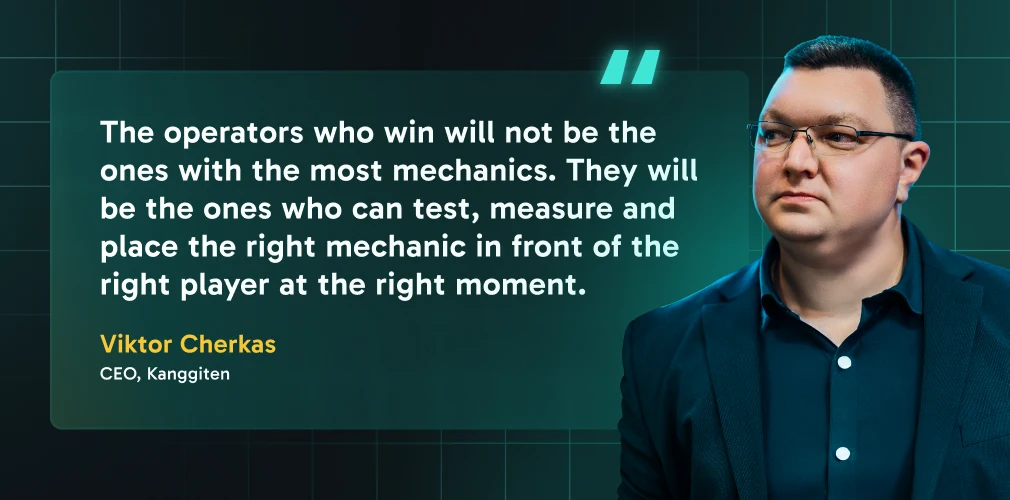
“The most underestimated factor is execution speed. Most operators already know what they should be doing. The difference is how quickly they can turn an idea into a live test, then scale it if it works.” — Viktor Cherkas, CEO, Kanggiten
Reading the right signals is what makes that speed useful. Find where registration traffic stops short of the deposit, and which payment methods fail more than they should. These leaks are easy to miss, which is what makes them costly. They are where the next month’s work gets pointed.
Days 31–60: Run The Experiments
By now you have a baseline, so the second month is for changing things deliberately. This is where white label casino integration starts to pay off. The CRM, analytics and payment data feed straight into controlled tests, instead of sitting in separate tools you reconcile by hand.
Test what you can measure:
- Registration flow: form length and field order, adjusted to the traffic source.
- Cashier: method mix, default amounts, and how declined deposits are recovered.
- Bonuses: structure and timing, tested by segment rather than sent to the whole base.
The cadence matters more than the count. Each result either earns a change a permanent place or rules it out. Segment-based reads matter here, because what lifts deposits for one traffic source can suppress them for another.
Days 61–90: Decide What To Scale
The third month is where you commit. By now, retention data has matured enough to trust. You can see repeat-deposit behaviour by cohort, and which players are paying back their acquisition cost. That is the basis for the bigger moves. You can add a GEO, expand your game content, or stand up a second brand on the same foundation.
On a platform built around configuration, these moves are setup work rather than development projects. A new market brings new registration fields, KYC steps and localised content, all adjustable per GEO. Adding payment providers or game studios as a market proves itself works the same way. The brand grows by configuration, with no rebuild each time it needs something new.
How White Label Casino Integration Decides Your Pace
Integration is usually pitched as a checklist: games connected, payments live, CRM switched on. Any provider can do that. What matters more is whether the connected parts share their data, because that is what lets a change in one place show up everywhere else.
Done well, the integration ties the pieces together. A returning player triggers an automatic bonus, deposits through the cashier, and the outcome lands in analytics you can read. Change a rule in the morning and you can see its effect by the evening. Done poorly, the pieces stay separate. Each runs in its own tool, and the analytics lag a day behind the campaign. Answering a simple question means exporting data and reconciling it by hand. The launch still happens either way. What you lose is the speed to fix things once players arrive.
Two things decide which version you get:
- Configuration over development. You should be able to adjust a registration flow, a bonus rule, or a payment route yourself, without raising a dev request.
- Shared data over stitched data. Player events, payments, and campaign results belong in one layer. When white label casino integration runs through a shared event system, a tournament result can trigger a reward, and you can see that reward’s effect on retention without pulling three reports together.
Why The Platform You Pick Still Matters After Launch
Choosing a provider is a decision about the speed and control you will work with every month afterwards. It is also the hardest part to judge upfront. A game count or a launch date is easy to compare. Day-to-day speed is not.
Kanggiten white label casino platform comes out of more than ten years of real B2C operations. It shapes the parts of the platform you lean on once players arrive. A stable PAM, a flexible bonus engine, real A/B testing, and segmentation you can act on the same day. The architecture is modular, so adding a GEO, a payment provider, or a second brand is a configuration change rather than a migration. Support is a named account manager who knows your brand.
VOX Casino Success Story
VOX Casino came to Kanggiten having outgrown a self-built platform. It had no native A/B testing, so product decisions ran on assumption, a thin bonus toolkit with no segment-level control, and key game providers missing across European markets.

Kanggiten ran a full migration to microservice architecture, live 2.5 months after signing. On that foundation, VOX ran 50 experiments across five funnel stages and added 26 new providers. Twelve months later, GGR was up 36%, day-14 retention up 27%, and average session length up 33%.
That capacity to keep improving is what the first 90 days, and every quarter after, actually depend on.
What Separates Operators In 2026
The hard part of this business has moved. Launching a casino used to take real skill. Now the tools are mature, the markets keep opening, and getting live is close to routine. What counts now is how well you run it afterwards.
Two changes are worth planning around. Retention is moving away from the fixed promo calendar. The platforms that perform now react to a player as their behaviour changes, rather than waiting for the next scheduled offer. Expansion is shifting too. On a modular platform, entering a new market or adding a second brand is a configuration job. Both reward speed. The faster you spot something in the numbers and act on it, the more you get from either shift.
When you start a white label casino, the decision that matters is what happens after go-live. Get your inputs ready, and pick a provider whose platform lets you change things quickly once players arrive.
If that is your plan, the next step is a direct conversation about your markets, traffic, and launch. Kanggiten can show you the platform and map a realistic timeline for a launch or migration. From there, we walk you through what the first 90 days would look like. Talk to our team when you are ready to begin.