


We bet you have already seen guides that read like they were written in 2019. Step one: get a license. Step two: pick some games. Step three: launch. This is what the majority get while investigating how to start an online casino.
That advice will get you burned in 2026.
Here’s why. The UK just doubled its Remote Gaming Duty to 40%. Brazil charges $6 million for a five-year license. Curaçao’s old master/sub-license shortcut is officially gone. The global online gambling market hit $87.69 billion in 2025 and is on track to nearly double by 2030. The opportunity is real. But the margin for error has compressed to almost nothing.
If you’re an affiliate team ready to run your own brand, an operator stuck on an unstable platform, or an investment fund entering the iGaming space, this guide was written for you. A working framework for launching a profitable online casino in a market that punishes slow decisions and rewards operators who get the fundamentals right.
At Kanggiten, we’ve launched and scaled 50+ brands on a platform built from 10+ years of real B2C operations. This is the playbook we’d hand to any partner on day one.
Key Takeaways
- The global market was $87.69 billion in 2025. UK tax doubled to 40%. Brazil charges $6M per license. Curaçao sub-licenses are gone. The opportunity is massive, but the margin for error has compressed significantly.
- Your licensing decision shapes everything downstream. Choose the jurisdiction before you select the platform.
- White label model gets you live faster. Turnkey gives you brand ownership and operational control. Each model fits a different stage and risk profile.
- Payment localization is non-negotiable. If your stack doesn’t match the market, conversion dies.
- Industry registration-to-deposit benchmark sits at 20–30%. Low minimum deposits, streamlined registration, and well-structured bonuses can push that above 45%.
- A healthy LTV:CAC ratio starts at 3:1. Build affiliate programs, localized SEO, and CRM-driven retention into your launch plan.
The $87.7 Billion Question: Why 2026 Is the Right (and Hardest) Year to Launch
Let’s skip the part where we tell you iGaming is growing. You already know that. What matters is where the growth is happening, what it costs to capture, and why most market analysis frameworks used by new entrants are already outdated.
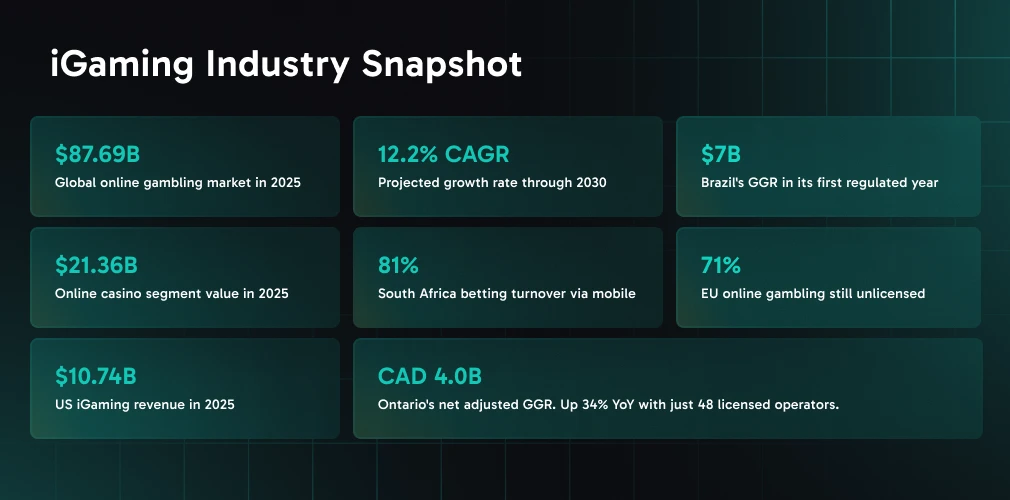
The online casino segment alone is worth $21.36 billion in 2025, growing at 12.2% CAGR. But context matters more than headlines.
In Europe, the total gambling market reached €123.4 billion in 2024, with online casinos already the continent’s largest digital gambling product at €21.5 billion. Yet roughly 71% of EU online gambling activity still runs through unlicensed sites. Regulation is tightening, but it hasn’t solved the black market problem. For new operators, this creates a paradox: compliance costs keep rising while unlicensed competitors keep undercutting on price.
The real growth story in 2026 is outside traditional European strongholds:
- Brazil’s regulated market produced roughly $7 billion in GGR in its first year, making it the fifth-largest betting market globally almost overnight.
- Ontario hit CAD 4.0 billion in net adjusted GGR, up 34% year over year, with just 48 operators.
- US iGaming revenue jumped 27.6% to $10.74 billion.
- In South Africa, 81% of betting turnover already comes through mobile.
The pattern is clear. Global markets are opening fast, mobile is the default, and the operators who win won’t be the ones with the biggest budgets. They’ll be the ones who pick the right market, localize properly, and launch before the licensing window narrows further.
This is exactly where Kanggiten operates. Not as a provider that hands you a template and walks away, but as an ecosystem already running across Europe, LatAm, CIS, Africa, and Asia. The infrastructure to enter these markets exists. The question is whether you move fast enough to use it.
How to Start an Online Casino Business: 7 Steps From Concept to First Deposit
The difference between operators who reach profitability and those who stall usually comes down to sequencing. Not what they did, but when they did it and how each decision shaped the next one. A licensing choice made in isolation locks you into a tax structure that kills your unit economics. A platform picked for speed leaves you stuck when you need to scale into a second market.
These seven steps are ordered deliberately. Each one builds on the previous. Skip ahead, and the cost compounds.
Step 1. Define Your Target Audience
Not every market deserves your attention. And not every promising market is right for your capital, your team, or your timeline.
Before you touch a platform or talk to a license provider, answer three questions: Who is your player? Where do they live? And what does it actually cost to reach them in that geography?
The differences are enormous. As we mentioned above, Brazil alone generated $7 billion in GGR in year one with 25.2 million bettors. But the license alone costs $6 million and 96% of transactions must run through Pix. Ontario’s 48 operators mean less competition but strict regulatory oversight. Spain has 77 licensed operators and 18.6% GGR growth, but tightening bonus restrictions are squeezing acquisition tactics. In Africa, over 90% of Kenyan bets settle via M-Pesa. The South African market prefers mobile. Thus, if your platform can’t process mobile money, you don’t have a product there.
The point isn’t to chase the biggest number. It’s to match your resources, your risk appetite, and your operational capability to a market where you can realistically compete.
Kanggiten approaches market entry through configuration, not custom development. Language, local payment methods, relevant game libraries, UX patterns adapted to regional behavior, and compliance logic are all adjustable per market. When an operator comes to us with a target geography, we don’t need to build from scratch. We configure what’s already proven.
Step 2. Secure the Right License (Before You Build Anything Else)
Your license shapes everything downstream. Tax exposure. Which payment providers will work with you. Which game studios will sign contracts. Where you can advertise. Even which affiliate networks will list your brand.
Choosing a jurisdiction isn’t a legal formality. It’s a commercial decision that will follow your business for years.
Here’s what the licensing landscape looks like in 2026:
Malta (MGA) remains the gold standard for European credibility. Application fee is €5,000 with a €25,000 annual base, plus 5% GGR tax (capped). Processing takes 4 to 6 months. The MGA currently oversees 315 companies across 323 licenses. It opens doors to most European markets and signals legitimacy to payment providers and affiliates alike.
Curaçao has changed fundamentally. The old master/sub-license model was abolished under the new LOK regime. Orange seal holders lost their authorization in October 2025. Annual fees sit at €47,450, with mandatory local infrastructure, a resident Key Person, and B2C/B2B separation now required. Still viable for operators targeting global markets outside the EU, but no longer the low-barrier entry point it once was.
The UK (UKGC) carries the highest compliance bar in the industry. Application fees range from £4,224 to £91,686 depending on scale, and there are currently 2,179 licensed operators. The headline change: Remote Gaming Duty doubled from 21% to 40% in April 2026, plus a 1.1% statutory levy. Operators need materially higher player lifetime value to maintain unit economics here.
Brazil demands BRL 30 million (~$6 million) per five-year authorization, covering up to three brands. With 78 operators licensed and the market already ranked fifth globally, this is a serious capital commitment for a serious opportunity.
The Netherlands serves as a cautionary example. Gambling tax is rising to 37.8% in 2026, while channelization has dropped below 50%. High taxes pushing players to unlicensed alternatives is a pattern operators should study before entering any regulated market.
The lesson across all jurisdictions: your licensing decision determines your cost structure, your competitive position, and how quickly you can move once you’re live.
As Ivan Korkin, Head of Account Management at Kanggiten, puts it: “Every market has its own operational and regulatory specifics. The challenge for operators is that entering a new GEO should not require rebuilding the entire platform from zero.”
Kanggiten approaches this through configurable market-level settings. Registration fields like CPF for Brazil, KYC verification flows, responsible gaming messaging, bonus limitations, and localized content all adjust per jurisdiction without a code rewrite. One platform. Multiple markets. No migration required.
Step 3. Choose Your Platform Model
How much does it cost to start an online casino in practice? Trust us, the right model is the point that determines the budget.
Three paths exist:
- A white label casino platform lets you operate under a provider’s existing license and infrastructure. On the broader market, launch timelines range from 4 to 12 weeks. Kanggiten delivers in 2 to 4 weeks. You trade some customization depth for speed and simplicity — ideal for teams entering the market for the first time or testing a new GEO.
- A turnkey iGaming platform gives you your own license, full brand ownership, and greater operational control. Market-standard timelines sit at 1 to 3 months. It suits operators ready to build long-term equity in their brand from day one.
- A custom build means developing proprietary technology from the ground up — full ownership, but $250,000+, a dedicated engineering team, and 6 to 12 months before you see a single registration.
The platform itself is only one budget line. Realistic planning means accounting for licensing, initial bankroll and reserves, game content fees (Tier-1 providers charge 10–20% of GGR), compliance staffing, and Year 1 marketing, which is almost always the largest single expense.
Kanggiten offers both white label and turnkey models. But the real advantage is architectural. The platform’s multi-brand setup lets operators launch a new brand direction in 1 to 2 days once the concept and creatives are ready.
As Ivan Korkin explains: “Multi-brand isn’t a technical convenience. It’s an operational growth tool. It lets businesses move faster, capture momentum, and adapt their market strategy without waiting months for a new platform setup.”
Configuration over custom development. That’s how you control costs without sacrificing flexibility.
Step 4. Build a Game Portfolio That Converts
Content is table stakes. Every operator has slots, live dealer, and table games. The difference is curation and commercial terms.
Evolution holds roughly 60% of the global live casino market with €2.07 billion in 2025 net revenue. Pragmatic Play, NetEnt, and similar Tier-1 studios typically charge 10–20% of GGR plus setup fees. These are non-negotiable partnerships for credibility and player expectations.
But a user-friendly lobby that surfaces the right games based on player segment will always outperform a wall of 50,000 titles nobody can navigate. User experience is the real differentiator here. No volume.
Kanggiten provides game aggregation as part of its ecosystem: 20,000+ titles, no separate aggregator contracts, no stacking third-party fees. One integration point. Full control over what your players see and when.
Step 5. Payment Options That Match Your Market
Get this wrong and nothing else matters.
In Brazil, 96% of legal iGaming transactions run through Pix. Crypto, credit cards, and cash are banned for betting. Also, as mentioned above, in Kenya, over 90% of online bets settle via M-Pesa. In Europe, open banking is growing at 23.4% CAGR, with Pay N Play models cutting authentication from 40 seconds to under 10.
Your payment options must be localized per GEO. Wrong mix equals dead conversion, regardless of how good your product is.
Kanggiten supports a wide range of payment integrations with GEO-specific configurations. The platform optimizes deposit UX, improves approval rates, and provides recovery scenarios for declined transactions. Not just processing payments, but engineering the payment methods flow for maximum conversion.
Step 6. Conversion Architecture: From Registration to First Deposit
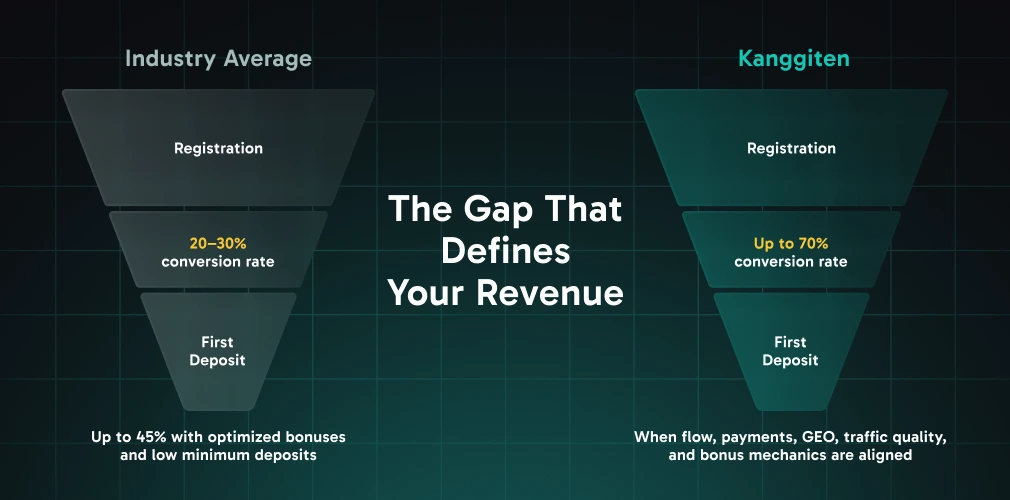
This is where operators win or lose. The industry benchmark for registration-to-first-deposit conversion sits at 20–30%. A study of 600 casinos and 200,000 clicks found that low minimum deposits lift FTDs up to 18%, while well-structured bonuses push that number up to 45%.
The three biggest conversion killers are the following:
- Registration friction (too many fields, not adapted to traffic source);
- Page performance at signup (unnecessary scripts slowing the experience before the player even creates an account);
- Rigid post-registration flows that don’t adapt to the player’s context.
Kanggiten operators achieve retention rates up to 39% versus the industry benchmark of roughly 30–35%. The platform supports configurable registration flows per GEO and traffic source, lightweight dedicated registration pages, and fully adjustable post-registration journeys. Continuous A/B testing and segment-based personalization come built in.
Step 7. Marketing Strategies and Player Acquisition
The most expensive line item. And the most underestimated.
DraftKings has disclosed a historical customer acquisition cost of $371 with a lifetime value of $2,500, a 6.75:1 ratio, on roughly $1.2 billion in annual marketing spend. You are not DraftKings. But the benchmark matters: a healthy LTV:CAC ratio starts at 3:1. Anything below that and you’re subsidizing players, not acquiring them.
In Tier-1 markets, affiliate CPA runs €30 to €250+ per first-time depositor. Tier-2 markets like LatAm and Africa offer materially lower costs but require genuine localization investment to convert.
New entrants need cost effective acquisition: affiliate programs, localized SEO, and CRM-driven retention from day one. Not a marketing budget that assumes infinite runway.
Kanggiten’s ecosystem includes FireAff for affiliate management and InTarget for marketing automation and CRM. No separate vendor contracts. Kanggiten operators get analytics, segment-based campaigns, and retention tools from launch, not as a Phase 2 add-on.
What “Built From B2C” Actually Means for Your Bottom Line
Kanggiten wasn’t built in a lab. It was built inside live B2C operations — 10+ years of managing funnels, testing bonus mechanics, fixing deposit flows at 2 a.m., and scaling under real traffic with real money. Every feature on the platform exists because it solved a problem an operator actually had.
That includes the parts nobody puts on a pitch deck. Payment reconciliation. Reserve management. Uptime when your highest-value players are active. Technical support at Kanggiten isn’t a helpdesk. You get a dedicated account manager, structured onboarding, 24/7 operational coverage, and new projects live within 2 to 4 weeks.
iGB about Kanggiten at ICE: “The platform lets operators bypass lengthy infrastructure development and go live faster — a modular ecosystem where you start with a core casino or sportsbook and expand with the components you actually need.”
The numbers behind it: 50+ active brands, 3M+ players, 7M+ monthly transactions, 99.9% uptime. Registration-to-deposit conversion up to 70%. Retention up to 39% versus the 30–34% industry benchmark. Financial stability baked into the architecture, not bolted on.
The key points that make this work in practice:
- Modular ecosystem. Use what you need. Scale without migration.
- Multi-brand architecture. New directions in days.
- Transparent partnerships. Fees, revenue models, responsibilities — all in the agreement. Nothing hidden.
- Built-in gamification. Tournaments, fortune wheels, rewards. No extra dev. No third-party fees.
- Conversion-first design. A/B testing, segmentation, configurable journeys.
What Comes Next
2026 rewards specificity. Jurisdiction that fits your capital. Platform that matches your growth plan. Payment methods your players actually use. The operators who define the next phase won’t outspend everyone else. They’ll own their data and scale on infrastructure that keeps up.
Kanggiten exists for exactly this kind of operator. Ready to move? Talk to our team.