




You’ve done the research. You know the market is growing. So why do most sportsbook launches still take twice as long as planned and cost more than the original budget?
Statista sports betting market data puts 2026 revenue at US$88.11bn. By 2030, the industry could nearly double to $187.39bn. The money is there.
Getting live is the hard part. Launch timelines slip. Platforms fail under real traffic. Payments don’t cover the regions you actually need, and compliance costs stack up before a single bet settles.
If you’re figuring out how to start your own sportsbook, the model and the licence come first.
Key Takeaways
- The model you pick (white label, turnkey, or proprietary) determines how fast you launch and how much it costs. Everything else sits downstream.
- Start a sportsbook in the right jurisdiction. The licence determines your payment access, game provider availability, and the markets you can legally serve.
- Payments are a retention lever. 34% of bettors rank payout speed as their top factor when choosing where to bet.
- Execution speed matters more than feature count. The operators who test and iterate fastest tend to win.
- Starting a sportsbook in 2026 means lower barriers and less competition than waiting. The window is structural. It won’t stay this open.
Why Is 2026 the Best Timing to Start?
US sports betting revenue reached $13.71bn in 2024, up 25.4% on the year before. The total handle was roughly $150bn. What’s worth noting: around 95% of that was wagered online. The volume has moved, and it’s not moving back.
Regulation is catching up. 38 US states plus DC and Puerto Rico have legalised sports betting, 30 of them online. Brazil opened its regulated market. Parts of Africa, Latin America, and Asia are writing licensing frameworks right now. For operators asking how to start an online sportsbook, each new jurisdiction is a window that rewards early entrants and punishes hesitation.
The online segment specifically is growing at 12.9% CAGR through 2030, but that growth is concentrated in newly regulated markets. Crowded GEOs reward scale. New ones reward speed. Run your market analysis before you pick a jurisdiction, not after.
Licence costs will only go up. Compliance requirements will tighten. Operators who start a sportsbook now build on lower barriers and less competition. By 2028, every market worth entering will have operators with a two-year head start. Starting a sportsbook today means you’re one of them, not chasing them.
How to Start Your Own Sportsbook?
This is a live operation with a full stack behind it. Licensing, platform, odds feed, trading, risk management, payments, CRM, compliance, support. Every item on that list is a cost line and a potential point of failure.
Three decisions set the direction before anything gets built.
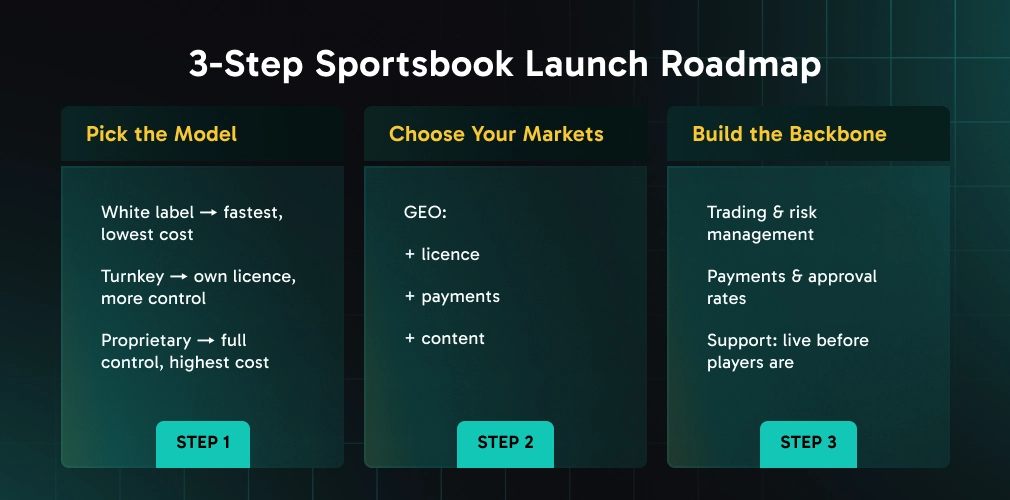
Step 1. Pick the Model
This choice sets your cost ceiling and your launch timeline. It also determines how much of the operation you actually own.
White label. The provider holds the licence and runs the infrastructure. You bring the brand, the traffic, and the marketing. The platform, odds feed, and trading are already there. You’re live in weeks, at the lowest upfront cost of the three models. What you give up is depth of control. Customisation has boundaries. The tech stack is shared. For teams with a clear target audience and a proven traffic source, white label is the fastest path to revenue.
Turnkey. You hold your own licence and run your own operations on a fully configured platform. More control over the product and the payment stack. More say over the player journey. It takes longer to launch because the licensing process runs in parallel, and costs more upfront. But the economics improve over time, especially if your business plan includes scaling across markets or running multiple brands.
Proprietary. You build everything yourself. Total control, but total cost and total maintenance burden. Realistic timelines stretch well past twelve months. This works for operators with deep engineering teams and very specific product needs. For everyone else, it is the slowest and most expensive route to a live product.
The right model depends on your capital, how fast you need to be live, and how much you need to own. An affiliate team with strong traffic and limited dev resources has no business building proprietary. A well-funded operator planning five GEOs should not be locked into a rigid white label. Get this wrong and every decision after it costs more to fix.
Step 2. Choose Your Markets and Product Depth
Your GEO selection drives the licence you need, the payment methods you integrate, the sports content you carry, and the compliance framework you operate within.
38 US states plus DC and Puerto Rico have legalised sports betting, 30 of them online. Brazil launched its regulated market. Africa, Latin America, and parts of Asia are opening up. Each new jurisdiction creates a short window for operators who arrive early and meet local requirements on day one.
Then there’s product depth. Live and in-play betting accounted for 62.35% of global betting-type share in 2025. Launching with pre-match only means ignoring where most player activity happens. Your platform needs to handle live odds updates and settle bets fast. Low-latency data feeds are table stakes for in-play. If any of that breaks during a peak event, players notice immediately.
Step 3. Build the Operational Backbone
Four systems need to work together from day one: trading, risk management, payments, and support.
Trading covers odds compilation, liability management, and live market updates. Most operators at launch rely on the platform provider’s trading team or a third-party feed rather than building their own desk. The question to ask: can your provider deliver the market depth and sport coverage your target GEOs actually need?
Risk management protects your margin. Exposure limits, bet acceptance rules, player profiling. All of this needs to be configurable by the operator, without waiting on dev cycles every time conditions change.
Payments connect the operation to the player. Deposit methods, withdrawal speed, approval rates. These directly affect whether someone completes their first bet and whether they come back tomorrow. Payments matter enough to get their own section later in this guide.
Technical support has to be live before your players are. Platform support for the operator, account management, and player-facing service are three separate functions with different staffing needs. A gap in any of them shows up in retention numbers within weeks.
When you create a sportsbook, the platform underneath has to meet a real baseline. Broad sport and league coverage. Deep markets within each event. In-play with low bet delay. Uptime that holds during peaks. If any of these fall short, your product is limited before your first campaign runs.
The user experience layer is a conversion surface. Registration flow, cashier design, bet slip behaviour, mobile performance. If you want to create a sportsbook that converts, these need to work natively within the platform. Bolted-on fixes are visible to players, and players leave.
Anyone working through how to create your own sportsbook for the first time should treat these specs as the entry requirement. The operators who skip this audit usually end up migrating platforms within twelve months.
How to Start a Legal Sportsbook?
The licence is the first hard gate. Without one, no reputable payment provider will integrate with you. No serious game aggregator will connect. Your domain risks being blocked in regulated markets.
Which licence you need depends on the model you chose in Step 1. White label operators go live under the provider’s existing licence. Turnkey operators hold their own. That distinction shapes your legal requirements, your timeline, and your upfront cost.
The jurisdiction you choose determines your tax obligations, payment access, game provider availability, and the markets you can legally serve. Options range from fast-entry frameworks like Curaçao to emerging jurisdictions like Anjouan and Tobique. They differ in compliance expectations, cost, and how many markets they actually open for you. Pick the wrong one and your licence becomes a constraint, not an enabler. Starting a sportsbook is hard enough without discovering six months in that your jurisdiction blocks the GEOs you need.
KYC, AML, and responsible gaming tools are required everywhere. Deposit limits, self-exclusion, reality checks. Regulators audit these actively. Get them wrong and the licence itself is at risk.
Kanggiten operates under Curaçao, Anjouan, and Tobique licences. The team works with each partner to match the jurisdiction to their GEO targets and business model. For white label operators, the licensing layer is already handled. For turnkey, the Kanggiten team supports the process from application through go-live.
How Much Money Do You Need to Start a Sportsbook?
The licence is the one cost line where numbers are public. Everything else varies by provider, model, and scope.
Curaçao CGA (post-LOK) charges a €4,592 application fee and €47,450 annually for a B2C licence that covers all verticals: casino, sportsbook, poker, live dealer under one licence. These are licensing costs only. Company formation, legal advisory, system audits, and compliance infrastructure sit on top.
Beyond licensing, your budget depends on the model. White label has the lowest upfront cost because infrastructure is shared. Turnkey sits in the middle. Proprietary carries the highest initial investment and ongoing maintenance.
Financial stability matters beyond the licensing checkbox. Underfunded launches are the most common reason sportsbooks stall after going live. The operators who plan for twelve to eighteen months of runway before profitability tend to be the ones still operating in year three.
The most cost effective path depends on your model, your GEO count, and your team. That’s a conversation worth having before you commit a budget to anything else.
Payments Decide Whether Bettors Stay or Leave
Operators often spend months on branding, odds coverage, and bonus mechanics. Payments get treated as plumbing. That’s a mistake.
Industry research by Paysafe paints a clear picture. In their 2025 “All the Ways Players Pay” survey of 4,300 bettors across 14 regulated markets, 34% ranked fast payouts as the single most important factor when choosing a sportsbook. Ahead of brand trust at 33%. Ahead of odds and promotions, both at 24%. Meanwhile, 82% said their payment experience directly influences whether they stay, and 32% of dormant bettors cited fraud concerns as the main reason they stopped.
Viktor Cherkas, CEO of Kanggiten: “When operators don’t have visibility into their payment flow, they lose control over one of the most critical parts of the player journey. We believe that at least 30% of potential VIP players actively look for platforms that can process withdrawals quickly and reliably.”
When you’re starting a sportsbook, your marketing strategies bring players in. Payments decide whether they stay. If your provider doesn’t give you control over PSP selection, routing logic, and how declined transactions are handled, that constraint shows up in every retention metric from month one.
Where Kanggiten Fits
Every section above describes a decision. Model, market, licence, payments, platform. The question operators ask after mapping all of that: who actually delivers this as one system?
Kanggiten is a white label sportsbook platform and turnkey ecosystem. The company has been running B2C operations for over 10 years, across 50+ active brands. That history shaped the product.
The sportsbook engine covers 100+ sport categories and 3,000+ markets. Monthly event volume runs above 100,000. Bet delay is 1 second. Market uptime runs above 90%. A dedicated 24/7 trading team manages odds and liability.
The architecture is modular. Operators take the components they need: sportsbook, casino, game aggregation, payments, affiliate management, CRM and marketing automation. Each module works independently and connects through a shared data layer. If one module is under heavy load, the rest keep running.
Operators configure their own PSPs, payment methods, routing logic, and withdrawal rules. Payout flows, approval thresholds, transaction limits. The operator sets these, not the provider. 300+ payment methods. 100+ countries.
Launches and migrations typically take weeks. Kanggiten’s multi-brand architecture makes it possible to bring a new brand or GEO live in days, assuming the concept and creative assets are ready to go.
Operators get a dedicated account manager from day one. Technical and operational support runs 24/7. Questions go to people, not forms.
EU Operator Migration Success Story
Starting a sportsbook on Kanggiten also means access to continuous A/B testing across the player funnel. One European operator experienced this firsthand.
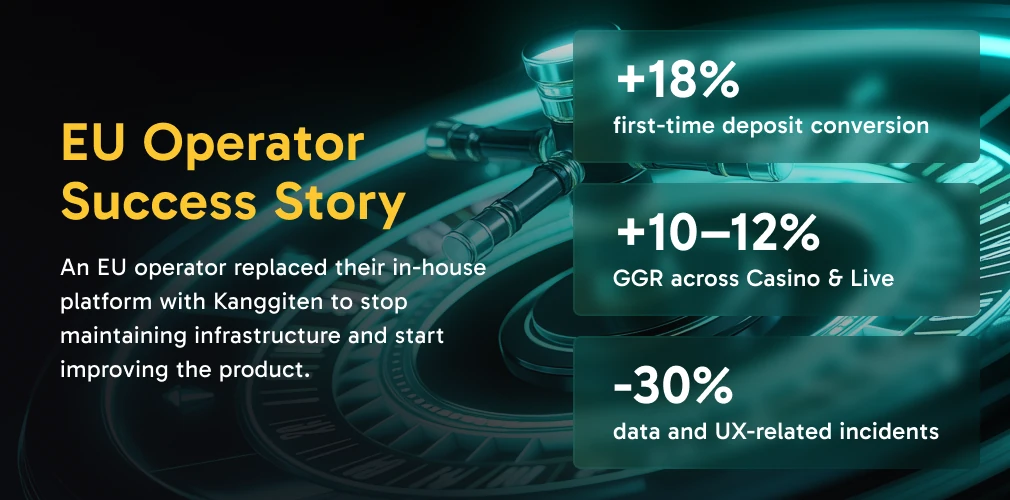
The brand had been running on a self-built platform. Technical debt was growing. Bugs took months to resolve. The team was spending more time maintaining infrastructure than improving the product. They migrated to Kanggiten and went live within weeks.
In the first year, the operator ran 30+ structured A/B tests across registration, deposit flows, and bonus mechanics. The results: +18% first-time deposit conversion, +10–12% GGR growth, and 30% fewer data and UX incidents. That case covers a casino, not a sportsbook module. But the operating model is identical. The platform provides the testing infrastructure. The operator brings the hypotheses.
For operators who want to create a sportsbook with full control over their economics, Kanggiten provides transparent commercial relationships. All agreements outline fees, revenue models, and operational responsibilities upfront. No hidden costs. No surprise commissions.
Whether you are figuring out how to start your own sportsbook as a first venture or migrating an existing brand off a platform that stopped scaling, the path follows the same structure: define the model, confirm the licence, configure the platform, go live. Starting a sportsbook here means the infrastructure decisions covered in this guide are already solved.
The Fast Path From Plan to First Bet
The industry is moving in one direction. Payouts are getting faster. Regulators are raising the bar. Players expect personalized experiences from their first session. The operators who figure out how to start your own sportsbook the right way will own the next five years. Everyone else will spend that time catching up.
Real-time behavioural segmentation is replacing calendar-based campaigns. Provider-agnostic infrastructure is becoming a baseline expectation. The ability to enter a new market or swap a PSP without rebuilding the core platform separates operators who grow from operators who maintain.
The decisions are clear. The timing is right. Starting a sportsbook in 2026 comes down to the infrastructure underneath. Talk to Kanggiten and find out how fast you can go live.