


The platform you pick is the one call you cannot walk back cheaply. Most things in your operation can be tuned later. The platform cannot, not without a migration that costs you months of revenue and rattles players mid-move.
So choosing among the best white label casino solutions 2026 has to offer comes down to one thing: the fewest regrets two years from now. You know the failure modes already. A player account system wobbles when traffic spikes. Launches pitched in weeks land in quarters. Conversion flattens and stops responding to whatever you try. Then come the smaller cuts: payment methods missing in your strongest geo, support that sends a ticket number when you need a person.
A white label lets you run a branded casino on a provider’s license and technology, which is the fastest way to go live. Our white label casino platform runs on that model, shaped by ten years of operating brands ourselves.
This guide ranks eight providers and shows you how to match one to your situation. No hype. Just the tradeoffs and the numbers that separate one from the next.
Key Takeaways
- The license decides your map. With a white label, you operate under the provider’s gambling license, which is what makes the launch quick. Markets that demand a local license stay out of reach.
- Conversion is a property of the platform. A provider that runs its own brands knows which funnel choices move the number, because it holds the data behind them.
- Modularity is insurance against the next migration. The white label casino solutions worth shortlisting add markets and features without a rebuild.
- The right provider depends on your profile. An affiliate team going independent weighs different things than a fund entering a new market.
- Support is either a relationship or a queue. The difference shows on your worst day, not your first.
Market Size Is Not the Same as Market Access
The market is large and still growing. Total gambling revenue is projected to reach around $655bn in 2026, with online formats making up more than $123bn of that. Europe is the biggest online region.
Size is not the access. Europe is not one market. It is a set of national ones, and Germany, Austria, Greece, and Romania rank among the largest. Each requires a local license to serve players there. That shapes how you read this list. Under the provider’s license, it opens a wide set of markets quickly. But for some regions you will still need your own license.
The 8 Best White Label Casino Solutions 2026
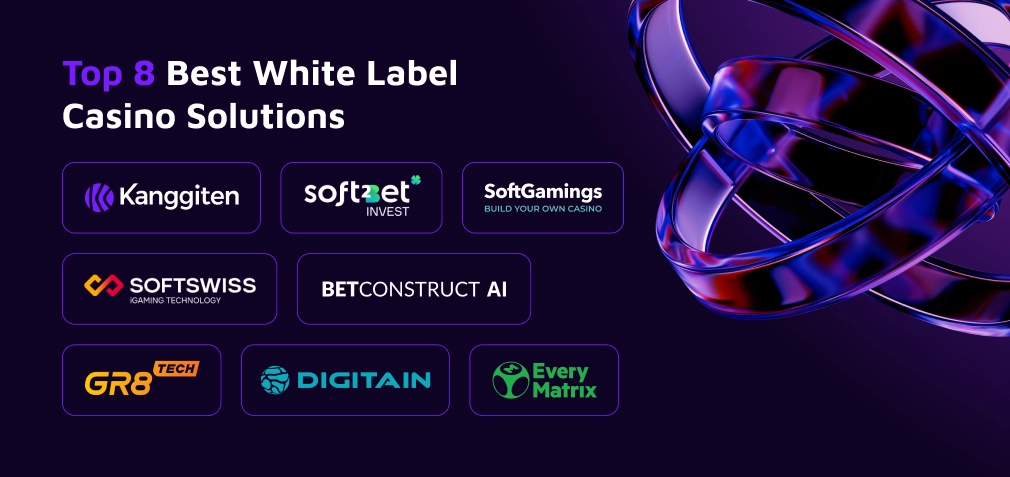
The eight providers here share a short list of strengths, and we ranked on what changes your results:
- Platform stability under load,
- A real conversion record,
- Payment and geo coverage,
- The support model,
- How open the commercials are.
Game breadth matters too, though most providers clear that bar now. All eight are established iGaming platforms with live operators behind them. So, the differences below are the ones that will decide your next two years.
1. Kanggiten
Kanggiten grew out of B2C operations. Ten years of running live brands taught them what converts before any of it became a product. Kanggiten ran the funnels themselves and kept the data.
The platform is modular. Start with what you need. Add the rest as you scale, with no migration to work through. Gamification is native to the platform, from tournaments and prize wheels to leaderboards and reward mechanics. The bonus engine is a proper system: rules, limits, and anti-abuse logic are wired into every promotion from the start. Support is a named account manager and a 24/7 team, with real access to people instead of a ticket queue.
Two things separate the platform in practice. The first is continuous A/B testing across the funnel, so the registration and deposit steps get shorter where the data supports it. The second is independence. Every module runs on its own, so there is no lock-in when you add a market or swap a piece.
The numbers: 50+ active brands, 99.9% uptime, over 20,000 games, and 300+ payment methods across 100+ countries. Conversion from registration to deposit reaches up to 70%, and retention up to 39%. Both figures depend on geo and traffic source. Operational setup runs 7 to 21 business days, and major platform deployments – 1 to 3.
2. Soft2Bet
Soft2Bet is a Malta-based group, founded in 2016. The brand portfolio is big, and it keeps growing. Cadabrus and Betinia are two of the casino and sportsbook names. Headcount is roughly 1,000, spread between Europe and the Americas. Buy it whole as a turnkey or white label build, or take only the modules you want. All of it is API-first and cloud-hosted.
MEGA is the engine, built in-house. It runs quests, levels, and rewards through the player experience, all pointed at retention and lifetime value. Soft2Bet also does its own KYC, anti-fraud, risk, and support. A smaller operator gets those ready-made. The build supports multi-market localization, with brands tailored by language, content, and payment mix. For an operator whose growth model leans on engagement mechanics, it earns a look. But always weigh the reference calls accordingly.
3. SOFTSWISS
SOFTSWISS started in 2009 and turned to iGaming around 2012. The company is now a big one. About 1,700 people work across roughly 30 countries, out of a Malta headquarters. That scale puts it among the larger houses here. The stack is modular and crypto-native: a core platform, a casino game aggregator pulling 40,000+ titles from 200+ studios through a single API, a sportsbook, the Affilka affiliate system, and the BGaming studio as a separate group company.
More than 250 brands run on it, with over six million monthly active players at 99.99% uptime. Crypto has been a first-class part of the product since 2013, with native wallets for the major coins, which is why crypto-first operators shortlist it. Recent moves include expansion into Latin America and South Africa and a new B2B prediction-markets product. Pricing runs at a premium tier, so treat the first call as a scoping exercise and budget accordingly.
4. BetConstruct
BetConstruct has more than two decades behind it and is led by founder and CEO Vigen Badalyan. Few suppliers match its breadth, and the whole range is built on the Spring platform and its SpringBME management layer. The range runs from sportsbook and sports data to RNG and live dealer games, poker, virtual and skill games, retail terminals, and a social platform.
Sportsbook is the heart of it. The book covers 120+ sports with tens of thousands of pre-match and live events, and the casino side reaches operators through an API of 350+ providers. Its licensing reaches more than a dozen jurisdictions, the MGA, the UK, and Romania’s ONJN among them. GLI and BMM handle the testing and certification. BetConstruct also runs its own B2C brand, VBET. That makes your platform supplier a competitor in some of your markets.
5. Digitain
Digitain has been around since 1999. It runs out of Yerevan and employs about 1,050 people across four continents. At heart it is a sportsbook software provider, and the book is the strongest part of the offer: more than 180,000 live monthly events, 4,000-plus markets, and an in-house team of over 1,300 traders and risk managers, with an AI recommendation engine on top.
On the platform side, Centrivo is the core, with the Paydrom payment gateway and Relum casino API rounding out the stack. Gaming content comes through aggregation and reads as secondary to sport, which is the honest way to frame it. Its client base runs past 150 partners. Regulated licenses have been landing quickly too, the UK, the Isle of Man, and Belgium among the recent ones. At the SBC Awards Americas 2026, it took Platform Provider of the Year. Strongest for operators whose center of gravity is sport, and a lighter fit if a gaming-led brand is your plan.
6. SoftGamings
SoftGamings goes back to around 2008, so it carries one of the longer histories here. The product line is wide. White label, turnkey, a self-service casino builder, and a standalone sportsbook are all on offer, so an operator can start small and add scope later. The real draw is a big game library and a setup that moves quickly. Payment integrations, a bonus system, and a single back office round it out.
On the map of providers, SoftGamings lands in the middle. It is lighter and quicker to launch than the enterprise platforms. Against the newer crypto-first shops, its edge is broader coverage. No single feature stands out. The sportsbook-led names go deeper on betting, and SOFTSWISS is more crypto-native. What SoftGamings offers instead is range, and the flexibility to take only the parts you need.
7. GR8 Tech
GR8 Tech markets itself around a “Platform for Champions” built for fast market entry and heavy traffic. Sportsbook is the heritage and the strongest module: the ULTIM8 sportsbook anchors the stack, with an in-house odds feed and a managed risk and trading service alongside. The wider stack adds casino aggregation, a CRM, a payment gateway, crypto and hyper turnkey builds, and the Aff.Tech affiliate tool.
The credentials hold up. ISO 27001, PCI DSS, and GLI certifications are all in place, and regulated licenses cover markets like Romania and Peru. GR8 Tech took Best Platform Provider 2026 at the SiGMA Eurasia Awards. Its sportsbook was relaunched in May 2026.
8. EveryMatrix
EveryMatrix started in 2008 in Malta as a white-label sportsbook business and grew into an enterprise, multi-vertical supplier. The company works across well over a dozen offices and serves 300-plus clients that include bet-at-home and NetBet. The stack breaks into five modules that each run on their own: CasinoEngine, the OddsMatrix sportsbook, GamMatrix for player management, MoneyMatrix for payments, and PartnerMatrix for affiliates.
The aggregator is among the biggest in the field. It pulls roughly 28,000 games from 300-plus suppliers into a single integration. Regulated-market reach is where it stands out. Direct licenses cover the UK, Malta, Sweden, Spain, Romania, and several US states, which shortens due diligence in each of them. Two caveats belong on the list. It left the UK B2C market in 2019, which still constrains UK access through the vendor.
How to Choose: Start with Your Profile
The best of the white label casino solutions here is the one that fits how you operate.
An affiliate or arbitrage team going independent should weight speed and conversion tooling. You have the traffic already. What you need is a platform that turns it into deposits and holds players once they arrive.
For an operator migrating off a limited platform, stability and a clean migration path come first. The goal is to move without losing players or data along the way.
Funds and new-market entrants should look hardest at the licensing route and the depth of support, since a first launch sets the template for everything after it.
And if your business runs on sport, study the sportsbook-led names above before you commit. A deep book matters more to you than to most operators here.
The industry keeps moving. AI-driven personalization is becoming standard, crypto rails are maturing, and regulated markets keep raising the bar on licensing. The providers that hold up are the ones built to adapt without a rebuild. The best white label online casino solutions in 2026 win on the same ground they always have: fewer regrets two years out.
FAQ
Which is the best white label casino provider?
If you are weighing the best white label casino solutions, start with fit. There is no single ideal choice. There is a good fit for your profile and your markets. The eight split apart on the criteria here. Each profile above shows where that provider is strong. So match the shortlist to how you run and the markets you want, and the right choice tends to become obvious.
What is a white label casino solution and how does it work?
With this model, your brand launches on a provider’s infrastructure. They hold the platform, the core technology, and the gambling license. You keep the brand, the marketing, and the player relationships. Under the hood you get player account management (PAM), a casino back office, and casino API integration to connect content and payments. This category is the closest thing to a ready-made casino platform, which is why teams choose it when speed matters.
White label or turnkey: what’s the difference?
Both get you a live operation. The difference is whose license you run on. Most white label casino solutions use the provider’s license and core technology, so you supply the brand and launch quickly. A turnkey model means you hold your own license. It takes longer to set up and costs more upfront, and it gives you full control plus the only legal route into locally regulated markets. Pick based on where you want to operate and how much you want to own.
What licenses come with a white label casino solution?
A white label runs on the provider’s master license, usually held in Curaçao, Anjouan, or Tobique. One setup covers a broad set of markets. It does not cover markets that require a local license. To serve players there legally, you need your own license, which points you toward a turnkey build. The best white label casino solutions are upfront about that limit.
How much does a white label casino cost?
There is no single figure, and any provider that quotes one without questions is guessing. Expect a setup fee, then either a revenue share or a monthly minimum, plus content and aggregator costs and payment processing fees. What moves the total is your market mix, the payment methods you need, and the level of support you want. Ask for a full cost breakdown before you sign, not a headline rate.
How long does it take to launch a white label casino?
Across the industry, white label casino solutions usually launch in a few weeks to a couple of months, depending on the provider and your requirements. On Kanggiten platform, operational setup runs 7 to 21 business days, and major platform deployments 1 to 3. The variables are your content selection, payment integrations, and how ready your brand assets are on day one.