


Your brand works. Players recognize it, affiliates send traffic that converts, and the domain has years of search history behind it.
The constraint lies one layer down. Whatever the platform can’t do, your team can’t do either. A bonus rule that needs rewriting before the weekend waits for a release cycle. Segment-level tests never get run, because the tooling has no concept of segments. Operators live with this for a while, then a flat quarter makes it hard to ignore, and two options end up on the table. Move the brand onto better infrastructure, or leave it behind and start again.
Most teams make this call on a setup quote and a gut read. The costly part of the decision never appears in the quote.
The same 8 questions come up in almost every migration conversation we have, usually in the same order. This guide works through all 8, so the casino platform migration vs launching new decision rests on numbers you can check.
Key Takeaways
- The license follows the legal entity, never the brand. That one fact decides whether white label casino or turnkey setup is even open to you, and it settles more migrations than any feature comparison does.
- Acquisition cost is where the two routes separate. A new brand rebuys every player you already have, at today’s prices, with no data to optimize against.
- Search authority belongs to the domain. Keep the domain through the move and years of ranking history come with it. Start over and you start at zero.
- Churn during a casino platform migration is a planning outcome. The friction points are known in advance, and most of them are avoidable with mapping and communication.
- A second brand is a growth decision. If the reason for starting over is that the technology can’t keep up, the budget is aimed at the wrong problem.
Two routes, two risk profiles
Both options sound like a fresh start. Only one of them actually is.
Replatforming keeps the brand and changes what runs underneath it. Same name, same domain, same player base, new infrastructure. The work is technical and operational: mapping account data, rebuilding bonus logic in a system that handles it differently, re-integrating payment providers, moving the game catalog, then cutting over. Nothing about the commercial position changes. Your affiliates keep promoting the same URL. The players who deposited last month can still log in. What changes is the range of things you can do next quarter.
Launching new resets the commercial position along with the technology. New brand, new domain, new player database at zero, new affiliate negotiations, new licensing paperwork depending on the route you take. The technology arrives clean, with no legacy configuration to untangle. Everything the old brand accumulated stays behind with it.
That difference reframes the whole build vs buy conversation. Framed as casino platform migration vs brand new, it isn’t a question about software quality, since both routes can land you on identical infrastructure. It’s now a question about which assets you’re willing to write off.
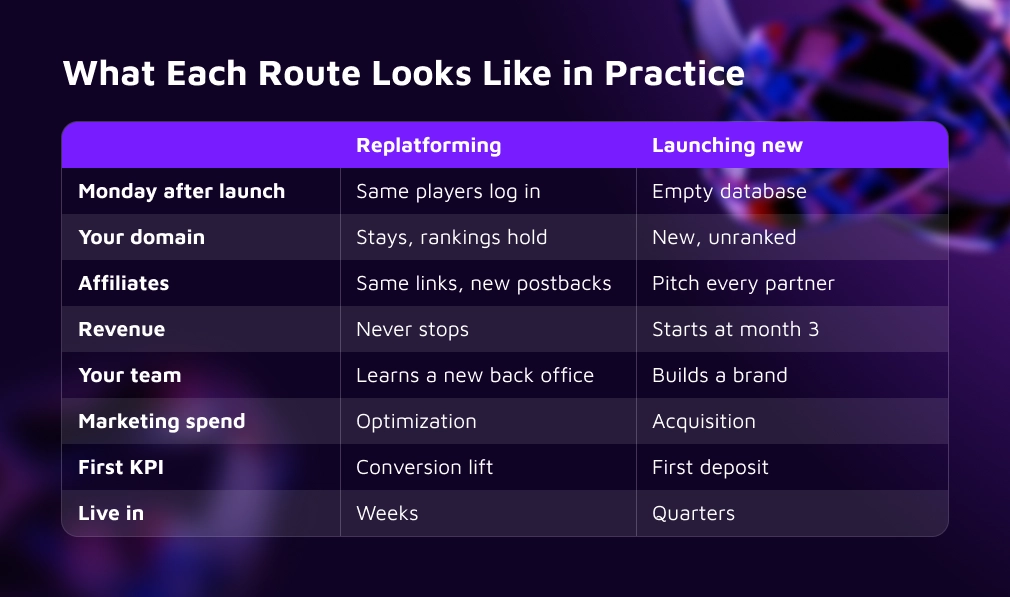
Here’s where operators get it wrong. A platform running out of road feels like a brand problem, because the symptoms show up in brand metrics. Conversion drifts down. Retention flattens. Player complaints cluster around the same three flows month after month. The instinct is to start clean. Replatforming solves the actual cause while the brand keeps earning, which is why it’s the route most operators land on once they price both.
8 Questions Operators Ask Before They Migrate
Some arrive during the first discovery call. Others surface much later, during due diligence, when a senior executive asks the one thing nobody prepared an answer for. The order below follows the order they tend to come in. Answer all 8 and casino platform migration vs launching new stops being a judgment call.
What actually transfers when you move a casino brand to a new platform?
Clearly, a brand isn’t one asset. It’s a stack of them, and they don’t all travel at the same speed.
The portable part is larger than most operators assume. Player account management records come across in full, including account identities, deposit and withdrawal history, balances, verification status, and the segments your CRM team spent two years refining. Your domain travels with everything attached to it, every ranking and every backlink. Brand recognition survives the switch untouched, since it lives in the player’s head rather than in a database. So does brand equity, the reason a returning player types your name into a browser instead of clicking whichever ad loads first. Your casino affiliate program keeps its partner relationships, though tracking links and postbacks need re-pointing at the new stack.
What doesn’t survive intact makes for a shorter and more irritating list. Bonus configurations rarely port cleanly, because every platform models wagering rules and eligibility differently, so the logic gets rebuilt rather than copied. Anything custom-built on the old stack stays there. Stored payment credentials belong to your payment providers rather than to you, so tokens tied to the previous integration usually have to be re-established. Analytics history often arrives in summary form instead of at event level, which matters if you plan to compare next year against last.
One item deserves a contract check before anything else. In some white label agreements the provider holds the domain and the legal player relationship. If that describes your setup, read the exit clause before you price either route, because it determines whether the list above is yours to move at all.
This is where casino platform migration vs launching new stops being a technology comparison. Identical infrastructure waits at the end of both routes. What differs is how much of that list you still own when you arrive.
Does the gaming license transfer with the brand?
No. The license attaches to the company that holds it, rather than to the brand name or the platform underneath it.
That splits the question into two very different situations.
If you operate under your own license, it stays with you through a migration. The entity doesn’t change, so neither does the license, and the brand keeps trading under it. Your supplier changes, and most license conditions define what has to be reported when that happens. Read yours before the project starts rather than after cutover.
If you operate under a provider’s master license, the picture changes. A white label casino runs on the third-party’s license, so switching platforms means switching the license you trade under. Kanggiten’s white label is covered by our master license across Curaçao, Anjouan, and Tobique. It is a fast route to market. It does not open locally regulated markets, where the regulator requires the operator to hold a local license in its own name.
That distinction decides more migrations than any feature does. If your growth plan runs toward locally regulated markets, you need a turnkey casino solution with your own license behind it, and the earlier that reaches the table the better.
Is it cheaper to migrate an existing casino or launch a new brand?
Almost always migration, and the gap is wider than the quotes suggest. Priced on setup fees alone, casino platform migration vs launching new looks like a close call.
Compare setup fees and the two routes look similar. Each involves a platform integration project, data work, and the same payment and content providers wired in. On that line alone a new brand can even look cheaper, because there’s no legacy data to map.
The gap opens on the lines that never appear in a proposal.
A new brand starts with an empty database. Every player who deposited with you last month has to be bought again, at whatever your customer acquisition cost happens to be in your markets right now. Multiply that by your active base and the number gets uncomfortable fast. Then add the ramp. A new brand earns nothing in month one and very little in month two, while the cost base runs at full rate from day one.
A migrated brand keeps depositing throughout. Revenue continues through the project, which turns the exercise from an investment you have to fund into a project you can fund from operations.
The honest cost of replatforming is narrower. Project work, a period of parallel running, and internal team hours that come out of the roadmap. Support volume also rises for a short window around the cutover.
Look at the total cost of ownership across 24 months rather than at the setup line. Count the acquisition spend and the revenue gap during ramp. Add a second license if the new brand needs one, plus the marketing budget required before a new name converts at the rate your current one already does.
One caveat. If your current agreement makes the player base hard to move, the calculation shifts. That’s a contract question, and it comes before the cost question.
How much money do you need to start an online casino?
There’s no single number, and any provider who offers one without asking about your markets is quoting a setup fee rather than a budget. What follows is the shape of the spend rather than its size.
Casino license cost comes first if you’re building a turnkey casino solution. It covers application, legal support, and the annual fees your regulator charges, and it varies widely by jurisdiction. White label removes that line, since you trade under the provider’s license, which is the main reason white label casino cost looks lower on paper.
Platform comes next, usually as a setup fee plus a monthly minimum or a revenue share. Game content and payment processing follow. Payments carry a detail that surprises first-time operators. Providers often hold a rolling reserve against chargebacks, so a share of your revenue stays out of reach for months.
Then there’s headcount. An online casino business needs support and payments staffed from week one. CRM and compliance follow immediately after, whatever the platform automates.
The largest line has nothing to do with technology. Acquisition. A new brand buys every visitor, because it has no affiliate history and no search presence to draw on, and it does that at the point where it has the least data to optimize with.
Add working capital for player winnings on top, since payouts don’t wait for your settlement cycle.
Set against that list, casino platform migration vs brand new stops looking like a close call. Most of those lines are already paid for in a brand you’re running today.
Will we lose search traffic when we migrate?
Not if the domain stays and the URLs are handled properly. Search equity attaches to the domain, so a website migration that keeps the address keeps the rankings that came with it.
The risk lives in execution. Replatforming usually changes URL structure, because the new system generates game pages, promotions, and category listings its own way. Old addresses stop resolving, and every ranking attached to them goes too, unless each one is mapped.
Four things decide the outcome.
Map every indexed URL before cutover and point a 301 redirect from each old address to its closest new equivalent. Google’s documentation on site moves with URL changes covers the process, and Google recommends keeping those redirects live for at least 180 days.
Hold the page content and structure where rankings already exist. A domain migration is the wrong moment to redesign the pages that earn your traffic.
Watch load times on the new stack. A slower site loses positions even with redirects in place.
Re-check internal linking after launch, since navigation templates often drop links that were carrying weight.
Expect a short dip either way. Rankings tend to settle within weeks when the mapping is complete.
Compare that with the alternative. A new brand launches on a new domain with no history and no backlinks, competing against operators who have been building the same signals for years. A casino platform migration risks a dip measured in weeks. A new domain starts at zero and stays there until you pay to change it.
Will players churn during a platform migration?
Some friction is unavoidable. Churn is not, and the difference comes down to what you ask players to do on the day of the switch.
The moments that cost you players are predictable. A forced password reset, sent with a poorly worded email, reads like a phishing attempt. Ask for verification documents a player already submitted and the brand looks like it forgot them. Payment methods that have to be re-added turn a two-tap deposit back into a form. Worst of all are bonus balances that don’t carry across, which produce the angriest tickets you will see all year.
Each of those is a planning decision rather than a technical inevitability. Map balances and bonus states before cutover. Players should hear about the change in advance, in their own language, from the brand rather than from a login error. Support needs to be staffed above normal for the first week and briefed on exactly what changed.

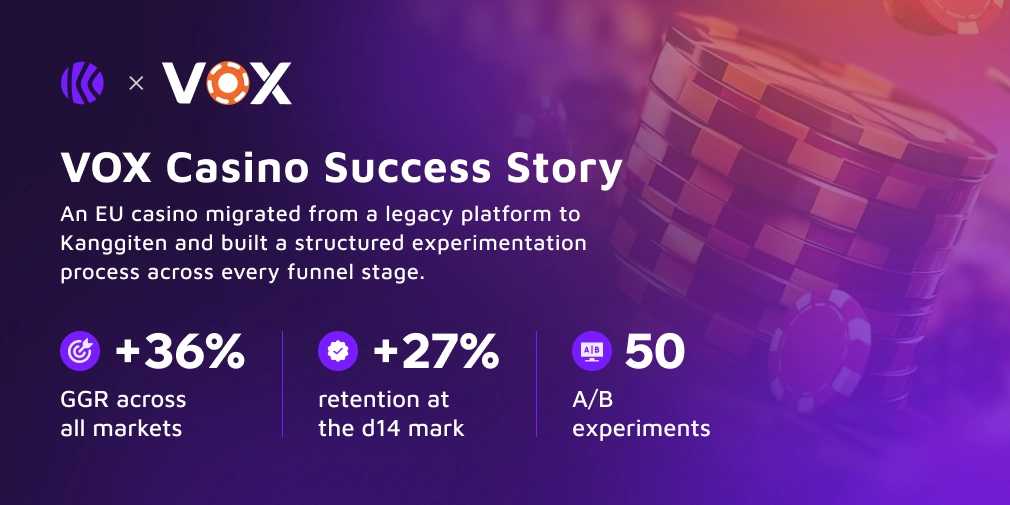
The portfolio data points the same way. Across the migrations documented in our case studies, player retention improved after the move rather than declining. VOX Casino recorded retention up 21% at d7, 27% at d14, and 22% at d30 in the 12 months following its migration. The reason is structural. The constraints that were suppressing retention disappear at cutover, and the tools that fix retention arrive in the same week.
That is the part casino platform migration vs brand new comparisons usually miss. The former puts a working brand on better infrastructure. The latter has to earn its retention curve from nothing.
How long does a casino platform migration take?
Two numbers matter here, and they answer different questions.
Operational setup on Kanggiten runs 7 to 21 business days. That covers the platform itself: environment, configuration, core integrations, and the brand going live. Major platform deployments run 1 to 3 business days, with zero downtime.
Total project time is a different figure, because it depends on what you’re carrying across. VOX Casino went live 2.5 months after contract signing, and the scope explains the gap. That project moved a full player base off a self-built legacy stack and integrated 26 new game providers along the way. An EU operator in our portfolio moved from an in-house stack and went live within weeks. Same process, different volume.
What drives the spread:
- Size and cleanliness of the player and transaction data being mapped
- Number of payment providers that need re-contracting or re-integration
- Game provider agreements that have to be novated or signed fresh
- Compliance review, which runs on your regulator’s clock rather than anyone else’s
- How much of your bonus logic was custom-built
Ivan Korkin, Head of Account Management at Kanggiten, describes the architecture behind the shorter end of that range: “The platform was designed so that operators do not need to rebuild the same foundation every time they launch a new product, brand, or market direction.”
Set against a launch from scratch, the time to market comparison isn’t close. A migration carries a live, revenue-generating brand across in weeks. A new launch adds licensing timelines, brand development, and a cold-start acquisition period before the first deposit lands. That is the practical difference in casino platform migration vs launching new terms. Moving a brand that already earns takes weeks. Getting a new one to the position the old one holds today takes quarters.
When is launching a new brand actually the better call?
There are real cases, and they share a common feature. The reason has nothing to do with your platform.
Regulatory reach is the clearest one. If your growth plan runs into a market where your current license can’t operate and your existing entity can’t hold a local one, a new brand under the right structure is the route.
Reputation is the second. A brand that has taken damage in a specific market, through a payment incident or a support failure that reached the forums, sometimes can’t be repaired at the pace the market moves. Rebranding there becomes a commercial decision, and no platform change fixes it.
The third is portfolio logic. Running every brand on one stack concentrates risk, and operators with scale increasingly want that spread across providers. A second brand also lets you test a different segment or price point without touching the positioning of the one that already earns.
None of those reasons is a complaint about your technology. That’s the test. If the reason for starting over is that the platform can’t keep up, you’re funding a marketing project to fix something replatforming would handle.
Ivan Korkin frames the multi-brand case as a growth tool rather than a technical feature: “For us, multi-brand is not just a technical convenience. It is an operational growth tool. It allows businesses to move faster, capture momentum, and adapt their market strategy without waiting months for a new platform setup.”
Worth noting: this is where casino platform migration vs brand new stops being binary. Migrate the brand that earns, then launch the second one on the same infrastructure once you’re there.
What about buying a brand that already exists?
A third route gets less attention than it deserves. Acquisition.
Listings for an online casino for sale appear regularly, and iGaming mergers and acquisitions have become a normal way to enter a market with a player base already attached. The logic of buying a business vs starting one matches the logic that favors migration. You pay once for assets that would otherwise take years to build.
Due diligence decides whether these deals work. Verify how the player data was collected and whether it can be transferred lawfully into your target markets. Confirm what the license permits and whether it can move with the entity. Read the platform agreement before anything else, because a brand locked into an exclusive provider contract is a brand you cannot move.
Acquisition doesn’t sidestep the casino platform migration vs launching new question. It answers it and leaves you a migration to run. You buy the brand, then move it onto infrastructure that can grow it.
Three migrations, twelve months each
Meet operators who settled casino platform migration vs launching new the same way. Three different starting points, one year of data each.
VOX Casino ran a self-built stack in European markets. No native A/B testing meant product decisions ran on opinion. The bonus toolkit had few mechanics and no segment-level control, and several key providers were missing from the catalog. After migrating to Kanggiten, the team ran 50 experiments across five funnel stages and added 26 providers with over 11,500 titles. Twelve months later, GGR was up 36% across all European markets, ARPU up 26%, LTV up 18%, and retention up 21% at d7, 27% at d14, and 22% at d30.
NV Casino had a different problem. The product was stable and the team couldn’t move it. Releases crawled, A/B testing was limited, and publishing a single game by hand took up to 72 hours. After the move that dropped to 15 minutes, and manual work fell 85%. A rebuilt two-step registration lifted conversion 16.5%. A clearer verification flow cut support tickets 34% and withdrawal times 22%. Turnover from returning players rose 29%, VIP LTV rose 22%, and the team ran 45+ experiments in its first year.
The Product Manager at NV Casino described the shift: “Moving to Kanggiten was more than a platform change for us. It changed how we build the product. We put our focus on experiments, user experience, and KPI growth. Over the first year, the team ran more than 45 product experiments and launched new features far faster.”
An NDA EU operator spent two years on an in-house stack before technical debt outran new features. Most engineering capacity went to maintenance. Two flat GGR quarters made the case. In the first year after replatforming, the team ran 30+ structured tests. First-time deposit conversion rose 18%, GGR grew 10 to 12% across Casino and Live, and D14 retention improved by 11 percentage points, while data and UX incidents fell 30%.
Three different constraints, and the same pattern after the move. The team stops maintaining and starts testing.
What to stress-test before you sign
Feature lists all look the same at demo stage. These questions separate providers.
Migration references at your data volume. Any iGaming platform provider can describe a process. Fewer can name operators who moved a comparable player base and say what went wrong along the way.
Who does the data mapping, and when it starts. If the answer arrives after contract signing, the timeline you were quoted covers setup rather than the project.
What changes without a developer. Bonus rules, registration fields, and cashier presets should be operator-configurable from the back office, along with payment routing. On Kanggiten they are, with development reserved for new mechanics rather than for daily campaign work.
What you can test in week one. A casino platform migration that lands you on an infrastructure without native A/B testing has shifted the constraint rather than removed it.
The exit terms. Domain ownership, player data portability, and notice periods belong in the conversation before signing, whether you take a white label casino or a turnkey casino solution.
Viktor Cherkas puts the priority plainly: “If retention is the priority, operators should look beyond feature lists.”
The provider that answers these directly is the one that has done this before.
Your next 30 days
Five steps will tell you more than another round of demos. Pull your own numbers first. Cost per acquired depositing player, active base, and monthly GGR. Those three figures price the option of starting over more accurately than any proposal will.
Read your current agreement next, specifically the clauses covering domain ownership, player data, and notice periods. They determine whether migration is available to you at all.
Inventory what transfers. Player records, search authority, and affiliate relationships are the assets in question. Put a number on rebuying them.
Request a migration plan rather than a quote. It should name the parallel-run window, the data mapping owner, and the rollback position if the cutover goes wrong.
Book the technical discovery. An hour with engineers on both sides surfaces more than a month of commercial conversation.
The direction of travel in this industry favors operators who can move. Regulatory conditions change, markets open and close, and infrastructure that can’t adapt becomes the ceiling on everything above it. That holds whether you run a white label casino today or a turnkey casino solution.
If you’re weighing casino platform migration vs launching new right now, bring us your numbers. The Kanggiten team will map what a migration looks like at your data volume, with the timeline and the risks stated up front.