

This isn’t a vendor pick. It’s a five-year commitment that shapes your margins, your compliance work, and whether you grow on this platform or migrate off it.
Launch goes fine. The problems come later. Conversion declines. Bugs you flagged months ago are still open, and payment approval rates start slipping in a key GEO. By then, the cost of switching isn’t technical. It’s traffic, retention, and players you already paid to acquire.
The stakes are real. The global online gambling market reached $107.3 billion in 2024. It’s growing at 11.5% CAGR through 2030. In Europe alone, total gambling GGR hit €123.4 billion, with online now claiming over 40% of that. The platform you pick today has to perform across that entire growth window.
Affiliate teams going independent, mid-market operators ready to scale, and investment-backed projects entering the online gambling market all face the same choice. So, what are the options? White label gets you live fast on the provider’s license. Turnkey gives you full ownership and the responsibilities that come with it.
Both look simple on a sales call. But white label vs turnkey casino solutions isn’t a product comparison – it’s a business model decision. The answer shapes your licensing position, your cost structure, and how much of the platform you actually control when things need to change fast.
Key Takeaways
- Licensing is getting expensive. MGA six-figure fees. Brazil’s R$30M grant. Curaçao’s new LOK framework. White label absorbs that cost. Turnkey assumes you’re ready for it.
- Both models let you customize. The question is how deep. UI, UX, promotions – available in white label and turnkey. Gamification math, compliance flows, CRM architecture – turnkey only. Know which layer your strategy actually needs.
- Speed compounds. White label has a head start. Every week without live traffic is lost revenue. Market CAGR is 11.5%. A 4–8 week white label launch and a multi-month turnkey mean different revenue outcomes.
- You scale on the platform you launch on. Switching later is expensive. Not because of the technical lift, but because you risk losing traffic, retention, and players you already paid to acquire. Get the architecture right at launch.
- Regulation is tightening. Fast. UK duty jumping to 40%. Brazil demanding local presence and GGR tax. Turnkey operators carry that load alone. White label shares it with the provider. Either way – the platform needs to handle compliance at the market level.
What Is a White Label Casino?
A white label setup runs on the provider’s license and infrastructure. The platform, regulatory cover, casino games catalog, live casino, payments, and back office stay on the vendor’s side. The operator owns the brand, the traffic, and the marketing.
The model removes the heaviest blockers to launch: licensing, legal compliance, payment contracts, studio agreements. Independent licensing is getting more expensive every year. The Malta Gaming Authority (MGA) mandates capital requirements and annual fees that reach six figures before a single bet is placed. In the UK, recent changes to gambling duties and license fees are pushing operating costs higher still. The trend is clear: the “regulatory tax” on independent operators keeps rising. White label skips that queue. Launch timeline: 4-8 weeks, not months of bureaucratic filing.
What the technology partner retains: the license, the platform’s core architecture, and the scope of data access. Capital goes where it drives revenue – acquisition, brand, player experience. The global market hit $107.3 billion in 2024. Online platforms now account for nearly 40% of total gambling revenue. The opportunity is there. The question is how fast you can get live to capture it.
When a White Label Model Is the Right Choice?
The white label iGaming platform fits best when speed and regulatory cover are the priorities. The industry average for a white label launch is 4–8 weeks. With Kanggiten, that window tightens to 2–4 weeks. For operators already on the platform, new brand directions can go live in 1–2 days once the concept and creatives are approved.
No application queue. No capital reserve lockup. No months waiting for regulator approval.
The urgency is real. Curaçao’s LOK regulations took effect in December 2024. The old sub-license system is gone. Now it’s local office space, resident staff, higher compliance bar. Independent licensing just got harder – and slower.
Why Is It Better to Use a White Label Casino?
No licensing fees. No compliance buildout. No payment infrastructure to negotiate from scratch. The initial investment goes straight into what generates revenue – traffic, brand, player experience. For operators with a defined market and a clear acquisition strategy, white label is the most cost effective path to first revenue.
What Is a Turnkey Casino?
Turnkey means full ownership. The brand, the operations, the gaming license – all under the operator’s control. The provider supplies the technology.
Both models cover the basics: UI, UX, layouts, content, promotions. Turnkey goes deeper. Gamification with customizable math behind tournaments, lotteries, and prize wheels. CRM is set up custom to the brand. Compliance flows for AML, KYC, responsible gaming, and data protection are custom-designed. Full CMS control. Pre-built game integrations, with room to add studios the operator wants.
Where Turnkey Fits
Turnkey works for operators who hold their own gaming license or plan to get one. The customization needs go beyond what white label covers. The market rewards that commitment: US commercial gaming revenue hit a record $78.72 billion in 2025. The most common reasons operators choose turnkey: custom gamification math, compliance flows designed for specific markets, a CRM built around the brand.
The turnkey casino platform doesn’t mean starting from zero. With Kanggiten, core components are reusable across projects. Registration flows, payment integrations, gamification, CRM. All configured and running in production. Customization happens on top of a proven foundation. Operators adjust what needs adjusting without rebuilding what already works.
Turnkey vs White Label Casino: How to Choose
Both models deliver a working iGaming business. The choice comes down to what the operator wants to own, how fast the brand needs to go live, and who holds the gaming license.
| White Label | Turnkey | |
|---|---|---|
| Launch | 4–8 weeks | 1–3 months with an existing license. 6–12 months if licensing is included |
| Gaming license | Provider’s. Licensing fee included in setup | Operator’s own. Licensing fee takes €5,000 app fee + €25,000 annual fee (MGA) |
| Customization scope | UI, UX, layouts, content, promotions | Same, plus unique features and design elements |
| Gamification | Standard mechanics package | Standard package, plus custom math |
| Compliance load | Managed by provider | Full AML/CDD responsibility (EU Regulation 2024/1620) |
| CRM | Preset stack with configuration | Custom setup |
When choosing between white label vs turnkey casino solutions, three questions usually decide it.
Who will hold the gaming license? Entry costs are climbing. Brazil’s Law No. 14.790 requires a R$30 million grant fee (approx. $5.1 million) plus a local physical presence. That’s the new baseline in a growing number of jurisdictions. Operators ready for that commitment go turnkey. Operators who prefer a leaner launch path start with white label and scale from there.
How much customization does the brand need? UI, UX, content, and promotions can be customized in both models. Unique features, gamification math, and compliance flows are turnkey-only. If the strategy doesn’t require them, white label is enough.
How fast does the brand need to go live? A white label launch and a custom-configured turnkey build run on different timelines. Active acquisition can’t wait.
Once those three answers are clear, the turnkey vs white label casino software choice tends to be obvious.
Why Operators Choose Kanggiten
Kanggiten was built inside a B2C operation that has been running for over a decade. 50+ active brands. 3M+ players. 7M+ monthly transactions. The platform came out of that operation, shaped by real traffic, real funnels, and real commercial pressure.
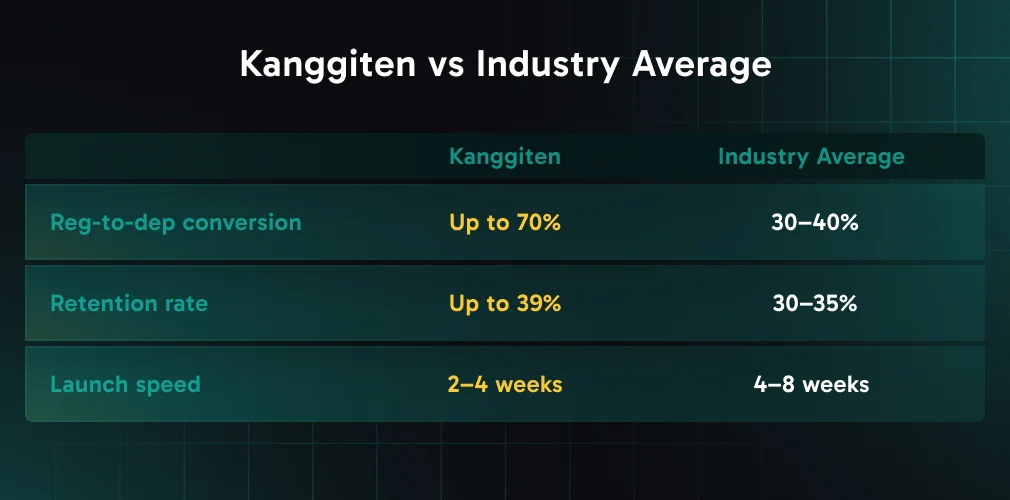
The numbers current operators work with:
- Up to 70% registration-to-deposit conversion (depending on GEO and traffic source)
- Up to 39% retention rate, against an industry benchmark of 30–35%
- Up to €1,000 ARPPU per month
- 99.9% platform uptime
- 20,000+ games from 150+ providers
- 2–4 week launch for new brands and migrations
That 70% reg-to-dep benchmark didn’t come from a single tweak. It came from stripping out the three friction points that kill conversion on most platforms.
- First: registration forms that don’t adapt to the market or traffic source.
- Second: front-end bloat – scripts, widgets, and tracking tools loading before a player even creates an account.
- Third: rigid post-registration flows that push every user through the same journey, regardless of GEO, bonus logic, or channel.
Kanggiten’s PAM makes each of these configurable. Operators control form length, page weight, and what happens after sign-up. The flow matches the traffic, not the other way around.
Those numbers hold when the full stack is aligned – registration, payments, traffic quality, bonus mechanics, onboarding. The platform gives operators the tools. But the outcome always depends on how well the setup fits the market.
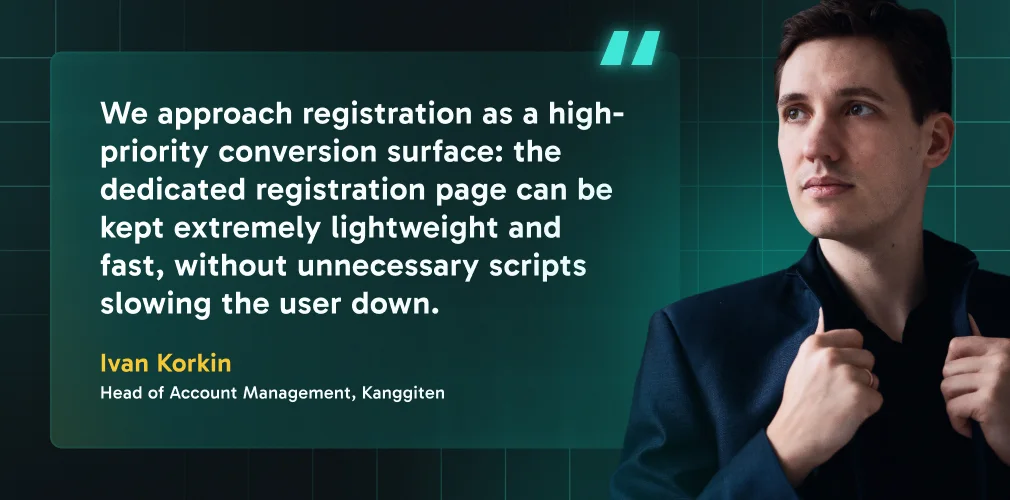
“We approach registration as a high-priority conversion surface: the dedicated registration page can be kept extremely lightweight and fast, without unnecessary scripts slowing the user down.” – Ivan Korkin, Head of Account Management at Kanggiten
The platform is modular. Operators choose the components they need and add more as the business grows. Casino, sportsbook, game aggregation, payments, analytics, affiliate management, CRM and marketing automation.
Registration flows use fewer steps to drive higher reg-to-dep conversion. Deposit UX is optimized for better approval rates, with additional scenarios for declined transactions. Core funnel stages run continuous A/B testing. And we don’t treat them as roadmap items. They were built to solve what Kanggiten observed across 50+ active brands over the years.
Gamification is built into the platform: tournaments, lotteries, prize wheels, achievements, loot boxes, and a store. Bonus mechanics are structured as a system, with welcome, retention, and weekly offers, clear rules, limits, and anti-abuse mechanisms.
Payments cover Europe, LatAm, CIS, Africa, and Asia. Localized payment methods, currencies, and deposit flows per market.
Every operator gets a dedicated account manager, 24/7 technical and operational support, full onboarding, and access to product tutorials and documentation.
Where the Market Is Going Next
The white label vs turnkey casino decision shapes the starting point. But the market keeps moving after launch. Three things are shifting right now that directly affect how this choice plays out.
Modular Architecture Is the New Standard
Mobile and tablet account for over 53% of global online gambling revenue. In Europe, the share is even higher. In Africa, mobile money drives the vast majority of betting volume. The platform needs to keep up. That means modular architecture where payments, CRM, gamification, and analytics can be added or swapped without rebuilding the foundation. The architecture you pick at launch decides what you can localize and scale six months later.
Every New Market Comes With Its Own Requirements
Online gambling now accounts for over 40% of Europe’s total gambling revenue. Up from 39% in 2024 and 37% the year before, according to EGBA. The market is growing, with online revenue projected to reach €66.8 billion by 2029. The regulatory pressure is growing even faster.
In the UK, Remote Gaming Duty hit 40% in April 2026. The Office for Budget Responsibility projects it will raise over £1.1 billion annually by the end of the decade. Brazil’s regulated market has been live since January 2025. It generated $7 billion in GGR in its first year. As of 2026, operators there face a 13% GGR tax, federal and municipal contributions, mandatory responsible gaming protocols, and facial-recognition KYC requirements.
Licensing, responsible gaming, AML. Every requirement is getting more detailed. More market-specific. Operators entering new GEOs today face a higher compliance baseline than two years ago. The platforms that handle that complexity at the market level give operators a cleaner path in.
In practice: registration fields that adapt to local requirements. CPF in Brazil, which also filters low-quality traffic early. KYC and responsible gaming flows per jurisdiction. Bonus mechanics and content localized per GEO. The operator moves from a broad MGA setup to a market-specific strategy without a code rewrite.
Speed Compounds
A market window doesn’t stay open indefinitely. Moving sooner means entering while the traffic is available – before a competitor claims it, before acquisition costs in a GEO climb. Every week between decision and live traffic is revenue that doesn’t exist yet. Operators who close that gap consistently build an edge that grows with every brand they add.
What Happens After Launch
The Model Gets You Live. The Partner Keeps You Growing. White label or turnkey – the choice shapes the first year of operations. What shapes the years after that is who you’re working with once the platform is live.
Post-launch is where the platform choice gets tested. Conversion performance, payment approval rates, feature delivery timelines – these unfold over months of real operations. How quickly issues get resolved and who’s actually reachable when they do is a practical question worth asking before you sign anything.
At Kanggiten, the support structure doesn’t change after the contract is signed. If something needs fixing, it gets fixed. If we see gaps before launch, we’ll flag them early and work through them together.
If you’re weighing your options, a strategy session is a practical starting point. We’ll map the right model to your situation, give you an honest timeline, and tell you what to expect at every stage.