


2026 marks what the industry now calls the “Professional Era.” Regulatory maturity is now the primary barrier to entry. Since 2024, high-growth GEOs like Brazil and New Zealand have moved from grey zones to strict licensing regimes. Brazil officially launched its regulated market in 2025 with a R$30 million ($5.5M+) license fee. New Zealand’s Online Casino Gambling Act 2026 shifted the landscape toward a capped, competitive auction model.
Player acquisition is changing shape too. Performance metrics are shifting from simple registrations to Lifetime Value. Taxes in mature jurisdictions have hit historic highs. Many regions now approach 25-30% of GGR. Denmark sits at 28%. The UK has gone further. As of April 2026, Remote Gaming Duty reached 40%. The Netherlands is close behind at 37.8%.
When tax and acquisition costs eat nearly 80 cents of every dollar, there’s no room left for operational inefficiency. Slow launches, fragmented tech stacks, manual compliance processes. None of it is sustainable at these economics.
The starting point varies. An affiliate network ready to own a brand. A fund entering iGaming with fresh capital. An operator outgrowing their current platform. The question is the same. How to start turnkey online casino on a foundation that holds up across jurisdictions. Without rebuilding your tech stack every time the market shifts.
Below is a decision framework covering infrastructure, licensing, conversion architecture, and scale. Written for the people who sign the contracts and carry the risk.
Key Takeaways
- Turnkey means ownership. You hold the license, control your player data, and build equity in your own brand from day one.
- Speed doesn’t have to cost you flexibility. Modern turnkey architecture launches in weeks and lets you configure funnels, bonuses, and UX per market. No custom dev cycle required.
- Conversion engineering multiplies your content advantage. A deep game library is a strong foundation., But pairing it with an optimized registration-to-deposit funnel is what turns content volume into actual revenue.
- Multi-brand capability is a growth multiplier. Testing new GEOs, traffic sources, and audience segments without rebuilding from scratch each time compresses your path to scale.
- Modular infrastructure eliminates the “rebuild or migrate” trap. The right turnkey ecosystem grows with you, adding regions, features, and integrations without platform migration.
- 2026 rewards operators who move fast and adapt faster. With 15+ jurisdictions updating frameworks, your platform partner’s ability to localize compliance, payments, and UX across territories is a competitive advantage, not a nice-to-have.
What Is a Turnkey Casino in 2026’s Regulatory Reality?
A turnkey online casino platform is a pre-built technology stack deployed under the operator’s own brand and license. PAM, game aggregation, payments, CRM, back-office – assembled, integrated, ready to go live. The client brings the business. The setup handles the infrastructure.
Simple concept. But the launch model you choose defines what you actually own. And that’s where most operators need clarity before committing budget and timeline.
Ownership First
A white-label setup gets brands live fast. The provider handles licensing. Upfront complexity stays low. A strong option for teams testing the market or prioritizing speed.
A turnkey model goes further. The operator holds their own license. Owns their player data. Controls platform configuration directly. For teams building long-term brand equity across multiple regions, that level of control is a strategic asset.
The Build-or-Buy Question
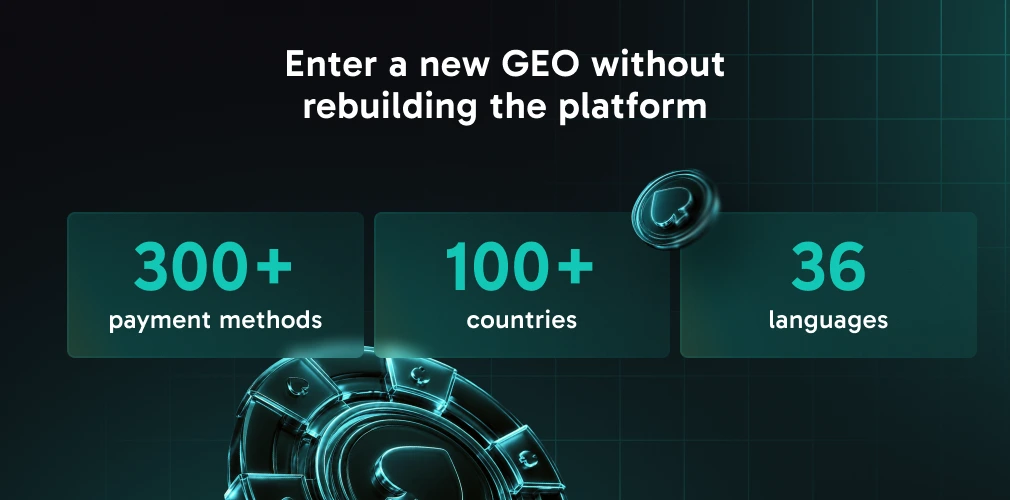
Custom development offers maximum flexibility. It also comes at a steep price. In 2026, an enterprise-grade infrastructure built to meet multi-jurisdictional standards can run past $1.5 million for the initial build phase alone. That’s before a single player registers.
Modern turnkey stacks close much of that flexibility gap through configuration. Launch timelines drop from years to an average of 6-16 weeks.
Orchestration vs. Aggregation
One more distinction worth noting. A game or payment aggregator connects you to content or transaction processing. A single function. A turnkey ecosystem orchestrates all of it in one operating system. Content, payments, compliance, player management, marketing. Integrated. Working together.
Why does this matter right now? Regulatory standards are rising fast.
Curaçao’s new framework (LOK) ended the era of sub-licensing. Operators must now interface directly with the Gaming Control Board (GCB). New application fees. Rigorous technical audits. A fundamentally different regulatory requirements bar.
In Europe, the cost of entry keeps climbing. “Responsible Gambling” engineering is now mandatory across most jurisdictions. Italian licenses have spiked to €7 million, specifically to filter for tech-savvy, well-capitalized operators.
The pattern is clear. Regulators are raising the bar everywhere. Businesses need infrastructure that gives them direct accountability over legal frameworks, data, and player relationships. That’s the core of turnkey solutions. Speed with ownership built in.
Five Layers of a Turnkey Casino Ecosystem
So what is turnkey iGaming software solution in practice? An ecosystem where each tier covers a distinct business function. Together, they do what would otherwise take months of sourcing, integrating, and troubleshooting across dozens of vendors.
The core platform layer manages everything player-facing and compliance-critical. Player account management. Bonus engine. KYC and AML workflows. Responsible gambling tools. This is the foundation – if it’s unstable, nothing built on top performs.
The content layer brings the product to life. Game aggregation across 50–300+ providers, typically delivering 5,000–20,000+ titles. Sportsbook engine, if the operator’s model requires it. Content variety counts, but content relevance to your target audience matters more.
The commercial layer drives acquisition and retention. Affiliate management system. CRM and marketing automation. Analytics and BI dashboards that surface performance data in real time.
The payments layer keeps revenue flowing. Integration with multiple payment providers. GEO-specific routing. Crypto support. Fraud detection.
Scale makes the difference here. Players place approximately $4.2 trillion in bets annually. Operators process $3.8 trillion in payouts. And most banks and card networks still classify iGaming as high-risk. That means decline rates well above the e-commerce average. Every percentage point of improved approval directly impacts the bottom line.
The operations layer holds it all together day to day. Back-office admin tools. Localization capabilities for language, content, and market-specific UX. Technical support – not a ticket queue, but a system built for speed and accountability.
The value of a turnkey ecosystem isn’t in any single layer. It’s in the integration between them. Payments connected to the bonus engine. Analytics feeding CRM triggers. Compliance adapting per jurisdiction without manual reconfiguration. That’s when a platform stops being a tool and becomes a differentiator.
The Business Case: Why Turnkey in 2026?
The market opportunity is well documented. Europe accounts for over 41% of global online gambling revenue. The largest regulated iGaming region in the world. Latin America is growing at 11.9% CAGR through 2030. The regional revenue reached approximately $6 billion in 2025. Expected to surpass $10 billion by 2028. Brazil alone drew over 270 operator gambling license applications before its regulated landscape even opened.
New territories are opening. Established ones are maturing. Both reward operators who can go live fast and adapt even faster. Speed matters. But the argument for turnkey in 2026 goes deeper. The business model itself has shifted.
Regulatory costs are higher than ever. License fees, responsible gambling engineering, multi-jurisdictional compliance, GEO-specific KYC workflows. Every new market adds operational weight. Building that infrastructure from scratch means absorbing it slowly. A turnkey ecosystem absorbs it once and scales it across every jurisdiction you enter.
The strongest case for turnkey in 2026 comes down to economics. Building everything yourself takes too long. Regulatory timelines don’t wait. A modular, operator-owned turnkey setup solves both. Fast to launch. Flexible to configure. Built to carry legal frameworks weight across regions without a rebuild each time.
How to Start a Turnkey Online Casino: Four Dimensions That Define Success
Launching a turnkey casino isn’t a linear sequence. It’s a set of interconnected decisions. Get one dimension wrong and it constrains everything else. Here’s what teams who scale profitably get right from the start.
The Regulatory Dimension
Your jurisdiction choice isn’t a compliance checkbox. It determines your available GEOs, payment corridors, content restrictions, and which platform partners can support you. Every decision downstream flows from this one.
MGA (Malta) remains gold standard for European credibility. As of mid-2025, 304 companies held active MGA licences, collectively covering 312 gaming authorisations (MGA). Broad access across regulated European territories. The benchmark for operators planning multi-jurisdictional presence.
Curaçao has historically been the faster path. That changed when the new LOK framework entered into force (CGA Portal) on December 24, 2024, replacing the previous sublicensing model with a single government-issued licensing regime. Mandatory local presence, AML programs, and responsible gaming frameworks are now required. Still viable for specific market strategies. No longer the shortcut it once was.
Brazil (SPA) (IGB) represents massive opportunity with specific requirements. Over 270 license applications before the regulated market even opened. Local registration fields like CPF. Local payment methods. Operators entering Brazil need a platform that adapts to these requirements without a full rebuild.
The strategic question is simple. Are you licensing for one GEO or building a multi-jurisdictional foundation? The answer changes your setup requirements entirely.
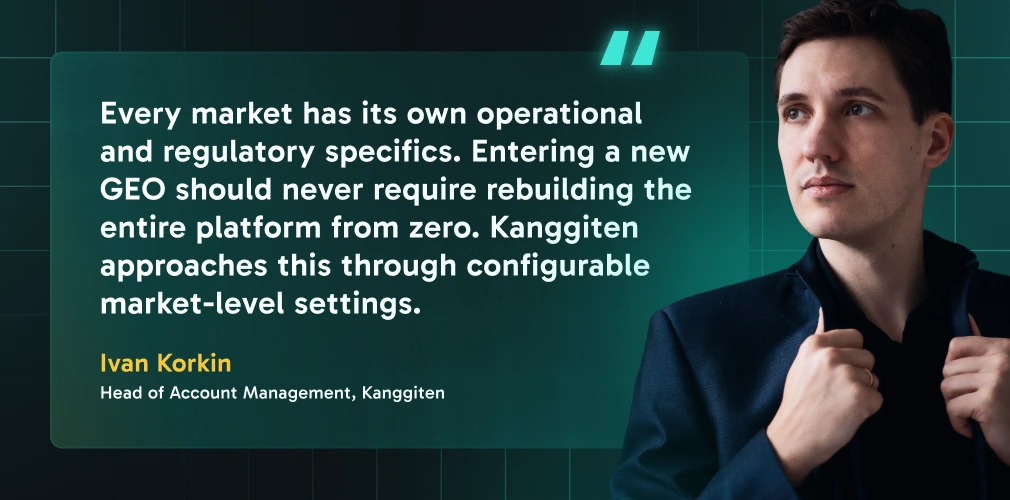
This is where infrastructure flexibility becomes a regulatory tool. As Ivan Korkin, Head of Account Management at Kanggiten, puts it: every jurisdiction has its own operational specifics. Entering a new GEO should never require rebuilding the system from zero. Kanggiten approaches this through configurable market-level settings. Registration flows, KYC logic, bonus limitations, payment options, localized content. All adjustable per jurisdiction without custom development cycles.
The Revenue Dimension
Conversion Levers
Most teams invest in traffic first. Funnel optimization comes second. The math runs the other way.
Industry average for registration-to-first-deposit performance sits between 25–40%. Varies by GEO, traffic source, and onboarding quality. Optimized platforms push that to 70% when the flow, payment setup, traffic quality, and bonus mechanics are aligned.
Same traffic. Same spend. Same acquisition cost. The difference between 30% and 70% is entirely in what happens after the click.
Three conversion levers matter most.
- Registration friction. Some markets require longer forms for regulatory reasons. Others convert better with minimal fields. The stack needs to support both. Adjustable per GEO. Configurable per traffic source. Independent UX research shows that reducing form fields from the average 12 to an optimized 6–8 can improve completion rates by up to 20%. In iGaming, where player intent is high and patience is low, that impact intensifies. Ivan Korkin, Head of Account Management at Kanggiten, frames it directly: “The biggest leak usually happens between first intent and first value.” If the registration experience is slow or overloaded, conversion drops immediately.
- Page performance. Many platforms load unnecessary scripts, widgets, and tracking tools before the user even creates an account. Registration is a high-priority conversion surface. It should be lightweight. Fast. Free of anything that slows the player down.
- Post-registration flow. What happens after signup defines whether the player deposits. Welcome bonus popup. Direct to the cashier. Email verification. Each path suits a different traffic source, GEO, and bonus strategy. A rigid post-registration flow forces every player through the same journey. A flexible one matches the journey to the context.
Retention Economics
Acquiring a player once is expensive. Keeping them active is where profitability compounds. Research from Bain & Company shows that a 5% increase in retention can boost profits by 25–95%. Built-in gamification supports this. Tournaments, prize wheels, leaderboards, structured bonus systems. Segment-based personalization goes deeper. Tailored offers for different player profiles. The industry average for retention hovers around 30–34%. Top-performing operators reach 39%. That gap translates directly to revenue. And it compounds month after month.
Payments and Mobile
Even the best funnel loses money if deposits fail. And in iGaming, they fail more often than most businesses expect. Banks and card networks treat the industry as high-risk. Authorization rates run well below e-commerce norms. Add emerging market banking infrastructure to the mix and the gap widens.
The fix is structural. Route transactions through multiple providers. Build in fallback logic for declines. Support local payment methods per GEO. Recover deposits that a single-provider setup would lose. These aren’t back-end optimizations. They show up on the P&L.
And all of this needs to work on mobile first. In key markets, mobile accounts for over 70% of iGaming activity. Deposits, registration, bonus claims – most players do everything from their phone. Website design and payment UX that aren’t built for small screens and fast decisions lose revenue at every step. That’s where your target audience is. Meet them there.
The Operations Dimension
Most “how to launch” guides stop at go-live, but the real work starts after.
KPIs from Day 1. GGR, NGR, player LTV, churn rate, bonus abuse rate. These need to be visible in real time. If your platform surfaces them in monthly reports, you’re reacting to problems that already cost you money. Operators who scale fast make decisions daily. The data infrastructure needs to match that pace.
Fraud and risk management. Estimated 3–5% of iGaming transactions involve fraudulent activity. Bonus abuse is the most common category. Automated KYC/AML workflows, transaction monitoring, anti-abuse mechanisms in the bonus engine. These systems need to run from launch.
Fraud and risk management. Roughly 3–5% of iGaming transactions involve fraudulent activity. Bonus abuse leads the list. This isn’t something you solve reactively. Automated KYC/AML workflows, transaction monitoring, anti-abuse logic in the bonus engine – all of it needs to be running before your first player registers. The cost of learning this lesson late is always higher than building it in from the start.
Support model. The real test comes when something breaks. A dedicated account manager who knows your infrastructure and responds fast. Or a ticket queue with a 24-hour response window. Teams who’ve experienced both understand the gap. It becomes visible in downtime and revenue.
Knowing when to scale. Conversion data tells you when a second brand, a new GEO, or an expanded game portfolio will generate ROI. The platform should let you act on that signal in days. If deploying a new brand direction takes months of setup and development, you’re missing market windows while competitors move.
How Long Does It Take to Start an Online Casino?
The honest answer depends on two things running in parallel: your licensing process and your platform setup. Neither waits for the other. The slower one sets the pace.
Licensing is the longest variable. An MGA application takes 3–6 months to process. The UKGC quotes 16 weeks as standard, often longer in practice. Curaçao’s new LOK framework has extended timelines beyond what operators were used to. Brazil’s process is still stabilizing after approving its first batch of 71 licenses in early 2025.
The platform side moves faster. Custom-built stacks typically require 12–18 months of development before roll out. Turnkey deployment compresses that significantly. Industry benchmarks for turnkey projects range from 6–16 weeks depending on the provider, GEO complexity, and regulatory requirements.
Three architectural principles separate fast deployments from slow ones. Modular ecosystem components reusable across projects. Configuration over custom development for launch-critical elements like registration flows, bonuses, and localized content. And infrastructure designed for multi-market expansion without rebuilding the core each time.
With licensing: 6–9 months total. The license determines the timeline.
Without licensing (already held): 6–16 weeks. Platform deployment, content setup, payment integration, compliance.
Timing matters in iGaming. A market opening or a regulatory shift creates opportunity. But only for companies whose setup lets them act while the window is still open.
Five Expensive Mistakes in the Creation of a Turnkey Online Casino
Not every turnkey launch succeeds. Knowing where others stumbled is just as valuable as knowing what to do right.
Mistake 1: Choosing On Price Alone
Low upfront cost feels like a win until the technical debt starts showing. Conversion underperforms, the infrastructure struggles under load, and eventually migration becomes unavoidable. The irony is that migration almost always costs more than what the operator saved by going cheap in the first place.
Mistake 2: Underestimating Legal Frameworks Complexity
An MGA license opens broad European access, but entering Brazil introduces an entirely different set of requirements. Local registration fields like CPF, different KYC steps, region-specific payment methods, responsible gambling rules that vary by jurisdiction. If the platform treats compliance as a one-size-fits-all setup, every new market turns into a months-long project.
Mistake 3: Launching Without a Conversion Strategy
A deep game catalog is a strong starting point. It’s not a business model on its own. Registration flows, bonus mechanics, and post-signup journeys need to be designed and tested before the first campaign goes live. Without that, acquisition spend generates traffic that never converts.
Mistake 4: Overlooking Operational Readiness
Everything looks fine on launch day. The problems surface a few weeks later when the back-office turns out to be clunky, support takes too long to respond, and the analytics dashboard doesn’t show what the team actually needs. Small operational gaps compound fast. They show up in churn before anyone connects the dots.
Mistake 5: Ignoring Data Ownership
This one tends to hurt the most, and the latest. Different providers handle player data differently. Some give full access and export capabilities. Others retain control on their side. The key is to understand exactly what you’re agreeing to before you sign. How is data stored? What can you export? What happens to it if you leave? These questions rarely feel urgent at the start. They become critical later.
All five mistakes share a common thread. The operator focused on getting live and didn’t pressure-test what happens after. A well-architected turnkey ecosystem is designed to prevent exactly these problems. But architecture quality varies widely across providers. Ask hard questions early. The answers will tell you more than any sales presentation.
What Makes the Creation of a Turnkey Online Casino Actually Work
Choosing a platform is a partnership decision. The technology matters, but so does the team behind it: how they operate, what they’ve built before, and what experience shaped the product.
Kanggiten was built from inside iGaming. Over 10 years of running real B2C execution across 50+ brands, serving 3M+ players, with 99.9% uptime. This is the result of building, fixing, and scaling casino businesses firsthand. That knowledge is now engineered into an ecosystem others can grow on.
What does that look like in practice?
Casino and sportsbook engines, game aggregation, payments, analytics, affiliate management, CRM and marketing automation – all built as one ecosystem. The modules were designed together, so they work together. Data flows between them without manual configuration or third-party middleware.
Conversion is engineered into the setup from the ground up. Registration flows adapt per GEO and traffic source. A/B testing runs across key funnel stages. Personalization works at the segment level. Gamification tools are built to drive retention over time, and it shows. Clients on the platform achieve retention rates of up to 39%, well above the 30–35% industry benchmark.
Partnerships run on transparency. Clear commercial terms. No hidden fees or surprise commissions. Every client gets direct account support, full onboarding, and 24/7 technical and operational support.
The Kanggiten turnkey platform was built for partners ready to open turnkey online casino with full ownership and control. Modular, fast, built to scale. Exploring how to start? Let’s talk specifics.