


In June and July 2026, Kalshi recorded over $58 billion in sports trading, and Polymarket came close to $22 billion. The World Cup ran across both months. During the tournament, prediction platforms took an estimated 27% of all legal US sports betting volume. By early August, combined weekly volume on Kalshi and Polymarket dropped below $10 billion for the first time since late June.
The spike faded soon after the final. An online sports operator without a Yes/No product at kickoff had no realistic way to add one mid-tournament. A new vendor integration can take months, and the tournament lasted just over five weeks.
Both formats let players back an outcome, but each sets prices and carries risk in its own way. Put prediction markets vs sports betting side by side, and the right fit for your brand becomes clear. On Kanggiten, operators get both. Prediction markets come as part of the sportsbook powered by DATA.BET, with no separate integration.
Key Takeaways
- Sports drive the volume. They account for most trading on the largest prediction platform, so the format competes for the same players as your sportsbook.
- Timing decides the upside. Demand for new formats peaks during major tournaments. A product that takes months to integrate arrives after the peak.
- Risk sets the two models apart. Both show players a price on an outcome. The main prediction markets vs sports betting split is who sets that price and who carries the risk.
- Crowd prices need a model. They tend to overvalue long shots, so automated pricing and position control protect the margin.
- Off-calendar events fill quiet days. Finance and crypto contracts give players a reason to log in between fixtures.
- One wallet removes a step. On Kanggiten, both formats share the sportsbook balance, so players skip a new registration and a new deposit.
How Does Sports Betting Work?
In a sportsbook, the operator is the bookmaker. It sets the price and takes the other side of every bet. Operators comparing sports betting vs prediction markets should start there.
Prices are shown as betting odds, and every price includes a margin. Say two evenly matched teams are both priced at 1.91. Players stake $100 on each team. The operator takes in $200 and pays $191 to the winners. The remaining $9 is its margin, 4.5% of everything staked.
Real bets are rarely split that evenly. A trading team adjusts the odds as money comes in and pauses bets on an outcome when the risk gets too high. The quality of odds and risk control decides how much of that margin the operator keeps.
Players also want choice, and ball games get the widest coverage. A football match starts with the winner and total goals. Player props go deeper, down to one striker’s shots on target. Live odds keep moving while the match is played.
Bets settle on the official result, usually the final score, and the operator pays winners from its own balance.
What Are Prediction Markets?
A prediction market lets people buy and sell contracts on the outcome of a real event. Each contract pays a fixed amount if the event happens and nothing if it does not. That makes the price easy to read. A contract trading at $0.62 means the crowd sees a 62% chance of that outcome.
Prices move as news arrives. If a star player is ruled out an hour before kickoff, his team’s Yes contract gets cheaper as traders react.
The idea started as a research tool. Economists ran small markets to forecast elections long before consumer apps arrived. For the academic background, see the definition from Wiki.
Today, the largest platforms also list contracts on politics and crypto. Sports still bring in the largest share of volume. From July 2024 to early May 2026, sports made up 80% of Kalshi volume and 39% of Polymarket volume.
How Do Prediction Markets Work?
Most prediction platforms run as exchanges. Traders buy Yes or No contracts from each other, and the platform usually charges a fee on trades. The Yes and No prices add up to about $1, so demand for one side makes the other cheaper.
Players can sell before the result. An early sale locks in a gain or cuts a loss. When the event resolves, winning contracts pay out in full. The rest expire at zero.
Some events have more than two outcomes. Each outcome then gets its own contract, such as a price range for Bitcoin at the end of the month.
A sportsbook can offer the same Yes/No format without running an exchange. A pricing model reads live market data and sets the odds, while the operator manages the risk like any other bet.
Prediction Markets vs Sports Betting Differences That Matter for Operators
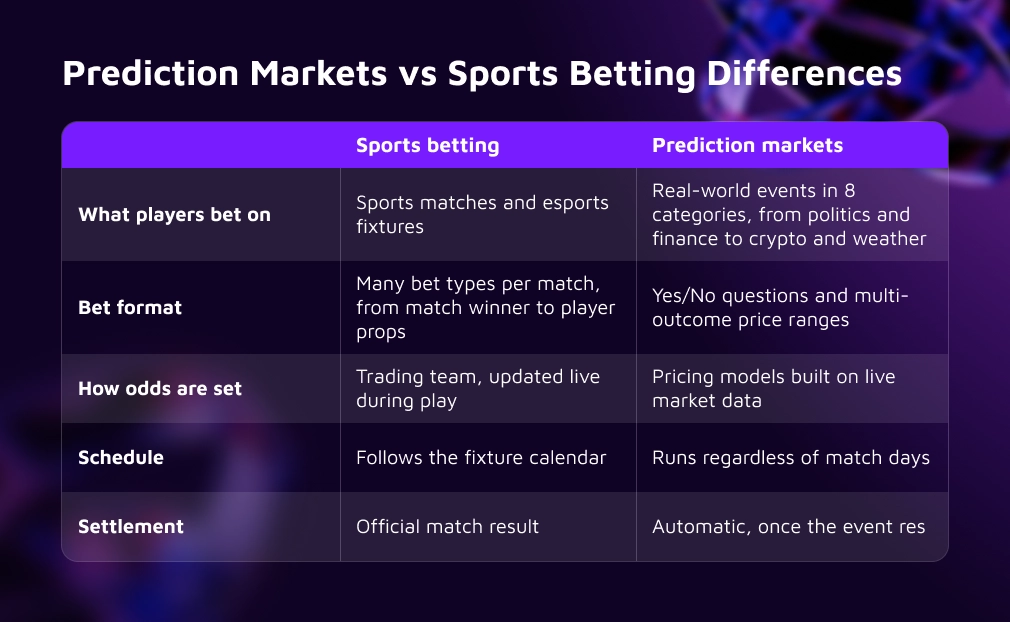
Start with who holds the risk. On an exchange, traders take opposite sides, and the platform earns a fee on each trade. Its income grows with activity, whatever the result. A sportsbook takes every position onto its own balance, so pricing quality and risk control decide its margin. Of every prediction markets vs sports betting difference, this one shapes revenue most.
Prices form in different ways. A sportsbook’s trading team sets the odds with a margin built in. Exchange prices come from whatever the latest traders agreed to pay.
Depth follows from how prices are made. A single football match on a sportsbook can carry dozens of bet types, from handicaps to corners, because the trading team prices them all. On an exchange, each contract needs its own buyers and sellers, and every one is a Yes/No question.
Timing comes next. Sportsbook demand follows the fixture list, peaking on match days and dipping in the off-season. Crypto prices and central bank decisions keep their own schedule. This gap in prediction markets vs traditional sports betting gives operators something to offer on days with a thin fixture list.
Engagement follows a different rhythm. An open contract keeps a live price until the event ends, so holders have a reason to check back as news breaks.
Account setup affects conversion. A separate account means a new registration and a first deposit on another platform. When both formats share one balance, a sportsbook player can place a first Yes/No bet without either step. That is the practical side of prediction markets vs sports betting for any brand with an existing player base.
How Behavioral Biases Affect Prediction Markets
Crowd prices carry human biases. The best-documented one is the favorite-longshot bias. People tend to overpay for long shots, which leaves strong favorites slightly underpriced.
A study of 300,000+ Kalshi contracts found that buyers of contracts priced under 10 cents lost over 60% of their money. The same research showed that accuracy improved as markets approached closing.
Fans who back their own team add more distortion, and so do traders chasing headlines. Bias shows up on both sides of the sports betting vs prediction markets divide.
These biases become a pricing problem once the operator carries the risk. A model that reads live market data and controls positions automatically stops heavy demand on one outcome from turning into a large exposure.
One Sportsbook, Two Formats: Prediction Markets on Kanggiten
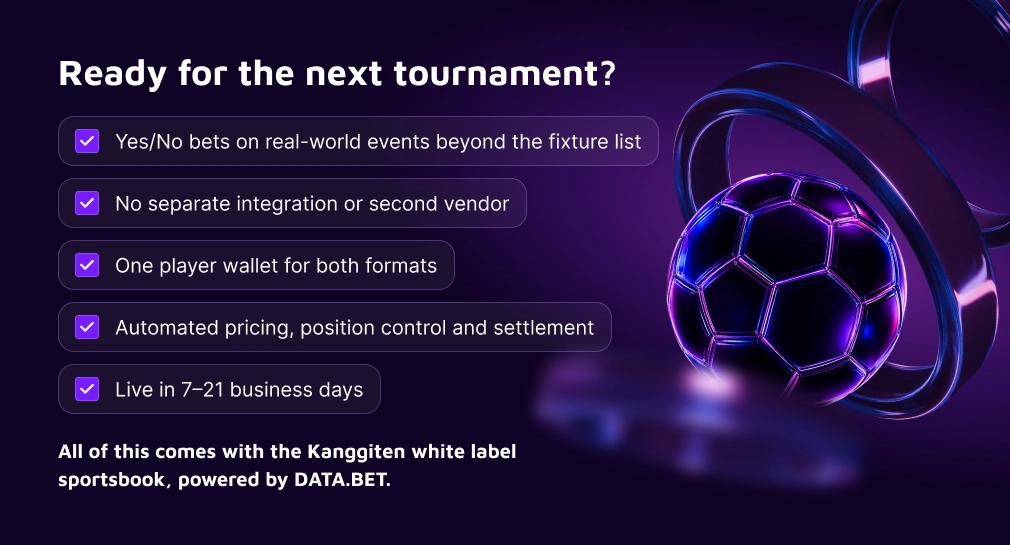
The Kanggiten white label sportsbook is powered by DATA.BET, and prediction markets come built in. Operators launch their brand onto the Kanggiten platform, and the Yes/No product goes live with the rest of the sportsbook. They do not need a separate integration or a second vendor contract.
That makes the prediction markets vs sports betting decision simpler. Both products share one sportsbook and one player wallet.
The DATA.BET prediction product covers eight categories of real-world events, from politics and finance to crypto and weather. Operators can run simple Yes/No contracts or multi-outcome markets built on price ranges. DATA.BET’s pricing models set the odds from live market data and handle position control and settlement automatically. Players bet from their existing balance, in fiat or crypto, and use the cash out and combo features they already know.
This solves the timing problem from the summer. The product is live from the day the brand launches. When the match calendar is quiet, events on their own schedule give players a reason to log in. As Ivan Korkin, Head of Account Management at Kanggiten, says, “In iGaming, timing often matters as much as the product itself.”
The sportsbook behind it covers 100,000+ events a month across 100+ categories and 3,000+ markets. A 24/7 trading team manages the lines, and live bets clear with a 1-second delay. The wider platform draws on 10+ years of B2C operations and runs 50+ active brands at 99.9% uptime. InTarget CRM and built-in gamification, such as tournaments and prize wheels, give operators the tools to bring event players back. Operational setup takes 7–21 business days on average.
Before the Next Big Tournament
The summer showed how quickly a new format can find an audience around a big event. The two models are also moving closer. Bloomberg reported that combo contracts, the prediction version of a parlay, were among the fastest-growing products during the tournament. A Bernstein analyst told the outlet that the growth was pushing traditional sportsbooks to offer something similar.
Viktor Cherkas, CEO of Kanggiten, describes where platforms are heading: “The winning platforms will not necessarily offer more. They will remove more irrelevant choices and friction.”
For operators, the next step after any prediction markets vs sports betting comparison is execution. The product has to be live inside the sportsbook before the next spike, on the same wallet and back office.
Three steps get a brand ready with Kanggiten:
- Book a demo. See the sportsbook and the prediction product live, including the back office.
- Map your GEOs. Review target regions and payment methods with the Kanggiten team. The platform supports 300+ payment methods across 100+ countries.
- Launch. Go live in 7–21 business days on average, with a dedicated account manager and 24/7 technical and operational support.
The next tournament is already on the calendar. Have both formats live before it starts. Let’s talk.