


During the 2026 World Cup, live markets generated 37% of turnover on DATA.BET, the provider behind the Kanggiten sportsbook. The share stayed steady from the group stage through the final.
In Tier-1 markets, that volume comes with strict rules. The UK and parts of the EU require the operator to hold its own local license. Australia prohibits online in-play wagering entirely.
For affiliate teams moving into operations and for operators planning a Tier-1 expansion, this sets the order of work. The license route comes first. It decides whether the project starts as white label or turnkey. The live betting platform decision follows, and it’s worth testing the shortlist during a busy weekend of fixtures. That’s when slow confirmations and gaps in risk control tend to show up.
Key Takeaways
- In Tier-1, each market’s licensing regime picks the launch model before features are compared.
- Bet delay is a margin control in any sports betting software, and the data source sets how low it can go.
- Live risk needs traders on every shift. On Kanggiten, that desk comes with the sportsbook.
- Major tournaments bring weeks of peak live load.
- If entering a new jurisdiction requires code changes, the platform will slow every expansion after it.
What Is a Live Betting Platform?
For players, live wagering means a bet placed after the event has started, as investopedia explains. Operators work with a wider definition. Their live betting platform covers the whole chain, from a goal on the pitch to a winning ticket paid into the player’s balance.
New sportsbooks rarely build their own pricing. Match data is licensed from an official sports data provider, and a trading engine turns it into the live odds feed. Behind the engine, a trading desk can pull any market when exposure looks wrong.
Once results are official, 99% of settlements on the Kanggiten sportsbook run without manual work. Much of the daily operational work happens in player account management (PAM), which holds balances and KYC status. Most withdrawal questions end up there. If you’d rather design your own interface, markets can come through a sportsbook API instead of the provider’s frontend.
Vendors don’t agree on where their job ends. A feed-only vendor supplies the live betting software core and leaves the PAM and payments for your team to integrate. A full-stack platform ships with both attached, which cuts the integrations you have to own.
On Kanggiten, the sportsbook powered by DATA.BET is already part of the platform. It runs on the same PAM and player wallet as the casino. A white label live betting solution therefore launches onto a connected stack.
How Does Live Betting Work for Operators?
For the operator, the critical part of in-play betting lasts a few seconds. Once a player taps a price, the request waits out a bet acceptance delay while the platform checks whether newer data has moved the market.
If nothing has changed and the stake fits the player’s limits, the bet is accepted. A moved price usually sends it back to the player, who can take the new odds or walk away. On the Kanggiten sportsbook, the delay runs down to 1 second.
Setting that delay is a commercial decision. Every extra second gives sharp bettors less room on stale prices. Casual players feel it too, and some will move to a book that confirms faster.
Why Tier-1 Raises the Price of Every Second
In affiliate marketing, Tier-1 covers the GEOs with the highest player value and CPA payouts, the UK and Germany among them. Affiliate teams already know what this traffic costs to buy. Running your own live betting platform puts that cost at risk on every rejected bet.
Demand concentrates at the top. In DATA.BET’s first year of sports trading, top-tier tournaments outperformed low-tier ones on every commercial metric. The Premier League was the most profitable tournament across its new clients. On those fixtures, a price that trails the feed by a second becomes direct exposure.
Rules keep moving after launch. Australia’s gambling reform bill, passed in August 2026, includes a ban on affiliate commissions tied to customer activity. That changes the commercial model for affiliate teams planning their own brand.
Whoever supplies the feed, the license holder answers for what the book offers and when markets close. That puts market-level controls on the requirement list for any live betting platform in these markets. Switching a market off for one jurisdiction should take a back-office setting. No release. Viktor Cherkas, CEO of Kanggiten, explains how responsibility is split.
“The license requirements of each GEO set the minimum the platform has to support technically. Within that frame, the operator decides how conservative to be. Our part is to make per-market configuration possible and keep every market properly isolated. Stricter settings in one market should never leak into another or get weakened by accident.”
Pick the License Before You Pick the Stack
Every target market falls into one of two groups. It accepts the license your provider already holds, or it requires one issued to you.
A white label sportsbook launches under the provider’s license. On the Kanggiten white label betting platform, your brand goes onto a prewired stack under Kanggiten’s master license. Licensing and KYC/AML for the covered markets are handled on that license. It does not open locally regulated markets such as the UK or parts of the EU.
Those markets require a turnkey live betting solution. Your entity holds the local license, and the Kanggiten turnkey sportsbook solution runs under it.
The two routes can run side by side. While the turnkey license application is under review, a white label brand can trade in covered markets. Both use the same live betting platform. A 24/7 trading team manages risk on the book either way.
| White label | Turnkey | |
| License | Kanggiten’s master license | Your own license for each regulated market |
| Markets it opens | Jurisdictions the master license covers | Locally regulated markets, including the UK and parts of the EU |
| Compliance | Kanggiten handles licensing and KYC/AML for covered markets | Your entity answers to the local regulator |
| What you control | Your brand, frontend, and bonus rules on Kanggiten’s prewired stack | An independent setup under your own entity, with full control of the stack |
| What comes first | Platform setup | License approval, then platform setup |
What Your Live Book Needs Before the First Kickoff
Four parts of a live betting platform decide whether the book holds margin and keeps players.
Bet Acceptance Speed and Odds Latency
Latency is the gap between an event on the pitch and the updated price on the player’s screen. The data source sets its floor. Official feeds taken close to the venue arrive first. That is why the Kanggiten sportsbook prices from licensed providers. Bet delay on any live betting platform can only shrink as far as that data allows.
The bet flow adds friction of its own. Operators on Kanggiten control the sportsbook frontend and UX per market and can shorten the path from price to confirmed bet for mobile traffic.
Sportsbook Risk Management With a Human Desk
Live exposure changes with each goal or card, and sharp accounts look for prices that have not caught up yet. DATA.BET, the sportsbook software provider behind the Kanggiten book, runs a desk of 150+ professional traders around the clock.
That desk comes with the sportsbook. Operators launching on Kanggiten do not need to recruit or train an odds team of their own.
You set base limits from the back office by player profile or market. The trading desk adds dynamic limits on top and tightens exposure on volatile markets in real time.
In-Play Depth That Keeps Players in the Match
A match-result market alone won’t hold anyone for 90 minutes. The Kanggiten sportsbook carries 100+ categories and 3,000+ markets, esports and virtual sports included, all priced from one feed before and during play. Cash out tends to come into play when a game swings. Same-game combinations do a different job, letting one ticket back a full reading of the match. Both belong in the live betting platform from launch.
Promotions add a second reason to stay. Free bets and other sportsbook rewards are configured from the Kanggiten back office. Segments update in real time. A player whose activity drops moves straight into a new campaign, and that campaign can mix casino and sportsbook rewards.
A Platform Layer That Holds Under Peak Load
Peak fixtures push deposits and bet volume up at the same time. A sportsbook platform has to absorb both without slowing the cashier or the price. Ivan Korkin, Head of Account Management at Kanggiten, explains how the modular design handles that load.
“Our platform is built from independent modules that communicate either through a shared data channel or via APIs. If one module, like a tournament or bonus engine, gets overloaded, it does not bring down the entire platform. Core functions like payments remain fully operational.”
Alerts compare current registrations and deposits with historical traffic, so a broken user flow is caught even while the servers look healthy.
Kanggiten’s live betting platform runs at 99.9% uptime with zero-downtime releases. Operators set their own payout rules across 300+ payment methods in 100+ countries, including which withdrawals run automatically.
Why Operators Build Their Live Book on Kanggiten
Kanggiten grew out of more than 10 years of B2C operations. Today, 50+ brands run on the platform across Europe, LatAm, CIS, Africa, and Asia.
The sportsbook is one module of that platform. You can start with sports alone and add the casino or other verticals later, with no forced bundle.
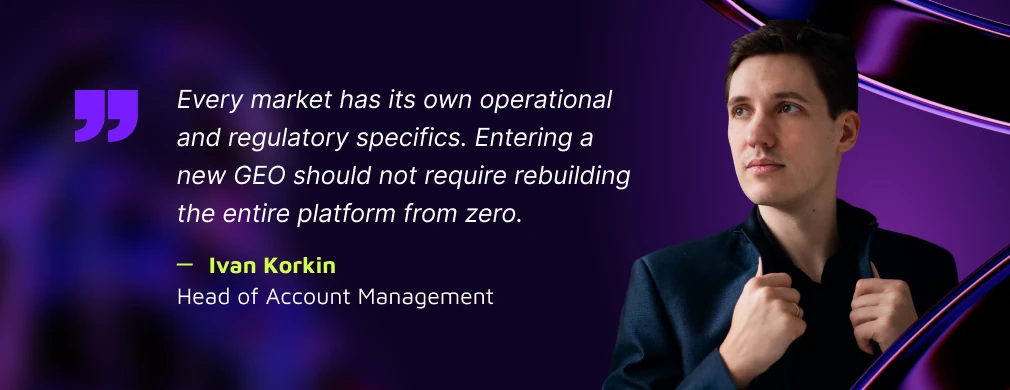
New jurisdictions are handled through configuration. Ivan Korkin describes the principle.
“Every market has its own operational and regulatory specifics. Entering a new GEO should not require rebuilding the entire platform from zero.”
Registration fields and KYC steps, for example, are set per market. FireAff and InTarget give affiliate teams partner tracking and CRM inside the same ecosystem.
Every white label live betting solution and turnkey build comes with a named account manager and 24/7 support. Fees and responsibilities are written into the agreement before launch, with no hidden commissions.
FAQ
What Is the Difference Between a White Label and Turnkey Sportsbook Solution?
License ownership and control of the setup separate the two models. A white label sportsbook solution puts your brand on the provider’s stack under the provider’s license. You launch without building a bet engine or a trading desk. Turnkey gives you an independent setup under your own license, with full control of the stack.
Does a White Label Live Betting Solution Include a License?
It does for the markets the provider’s license covers. Kanggiten’s white label brands launch under its master license. The UK and parts of the EU require the operator’s own license, which means a turnkey live betting solution.
How Much Does It Cost to Launch a Live Betting Brand?
Cost depends mainly on the license route and the markets you target. With a white label live betting solution, the license is part of the package for covered markets. Turnkey adds your own license application and local compliance resources. Trading is another major line on a live betting platform. Kanggiten includes trading in the sportsbook, which keeps an odds team off your payroll. Budget separately for Tier-1 acquisition and for working capital against player liabilities. Kanggiten sets out the full fee structure in the agreement.
How Long Does It Take to Launch a Turnkey Sportsbook?
Platform setup runs 7 to 21 business days from signed agreement to launch, and major deployments after that take 1 to 3 business days. In a locally regulated market, the license sets the overall timeline. A turnkey live betting solution can only open to players once the regulator approves your application. If you are working out how to start a sportsbook in a Tier-1 market, file the license application first. Live betting platform setup can then run in the final weeks before approval.
From Shortlist to Kickoff, and What Comes Next
A Tier-1 launch moves through five steps:
- Map each target market to its licensing regime.
- Choose white label, turnkey, or both.
- Test bet delay and risk controls on a demo before you sign anything.
- Configure market-level settings and payment routes per jurisdiction.
- After launch, run offers by player segment and keep scaling the ones that move retention.
The live product keeps developing after the first season. Micro-markets that settle within minutes and betting inside the live stream are the next formats reaching mainstream sportsbooks. Regulation is tightening in parallel, especially around advertising and affiliate models.
Viktor Cherkas sees execution speed as the deciding factor once a brand is trading.
“Most operators already know what they should be doing. The difference is how quickly they can turn an idea into a live test and then scale it if it works.”
If your target list includes locally regulated markets, plan for a turnkey live betting solution from the start. Book a demo with Kanggiten to review your markets and test the platform yourself.