


Most operators we talk to didn’t plan to get stuck with their platform. At launch, they chose the setup that made the most sense at the time. The bonus engine was fine for the first few campaigns. Player data sat in the back office, and nobody thought to ask if it could actually be exported. Fast forward a few years and those small calls have turned into vendor lock-in. Usually the team only finds out when it starts looking for the exit.
For a casino or sportsbook, the stakes are higher than for a typical software buyer. The platform holds player balances, KYC records, open bets, bonus progress and affiliate data. It also sets how fast you can react to the market, whether that’s a new bonus mechanic, a new GEO or a new tournament format. When all of this runs through one closed system, every change waits on someone else’s roadmap. Moving away means moving the whole business at once.
Below we cover what vendor lock-in looks like on an iGaming platform, how to count what it costs you, and which contract terms protect you next time. Kanggiten grew out of 10+ years of running B2C brands, so a lot of this comes from our own migrations and from operators who moved to us.
Key Takeaways
- Vendor lock-in usually shows up as slow growth first: tests you can’t run and features that never ship. That lost revenue rarely appears in any report.
- Your player data is the asset worth protecting. If you can’t export balances, bonus states and transaction history, leaving will hurt.
- Exit terms are cheapest to agree before you sign.
- A modular platform keeps your options open, and it also makes day-to-day work faster.
What Is Vendor Lock-In?
Vendor lock-in means leaving a supplier would cost you so much money, time or risk that you stay with it even when it no longer fits. The product still runs. But moving away looks harder than living with its limits. In economics, this is known as switching costs. In software it tends to grow every year, as more of your data, processes and people depend on one system.
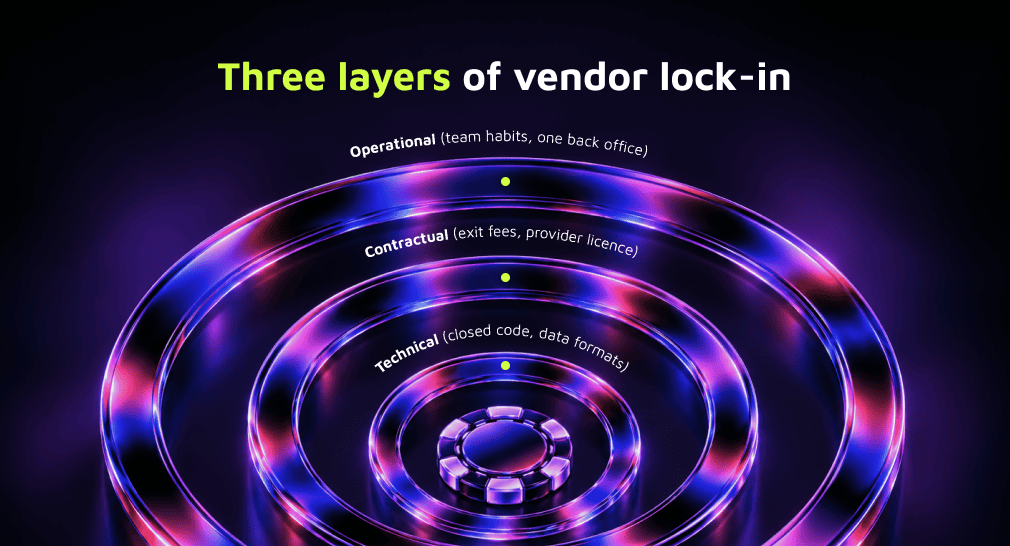
We usually see it in three forms:
- Technical. Proprietary software, closed data formats and custom integrations that only run on one vendor’s stack.
- Contractual. Long minimum terms, exit fees, a provider-held licence, or IP clauses that give the vendor rights to your custom features.
- Operational. Reports, workflows and team habits built around one back office. Moving means retraining everyone.
The hardest case is when one iGaming software provider controls the code, the data model and the licence at the same time.
Regulators have noticed this problem too. The EU Data Act has applied since September 2025. Under it, cloud and SaaS providers that serve EU customers must remove obstacles to switching and phase out switching charges by January 2027. Whether this covers a particular gaming platform is a legal question for your lawyers. Still, it shows where the market is going: customers expect to be able to leave.
Ivan Korkin, Head of Account Management at Kanggiten, sees the same shift from the infrastructure side:
“Operators must prioritize a ‘provider-agnostic’ approach to their infrastructure. Over the next few years, the ability to rapidly adapt to changing regulations and execute seamless, disruption-free migrations between cloud providers will be paramount.”
Why Operators Feel It More Than Most
A SaaS company that changes its project tool loses a few weeks of workflow. An operator that moves badly loses players. An iGaming platform provider usually holds:
- player balances and wallet history;
- KYC status and verification documents;
- active bonuses with partial wagering progress;
- affiliate tags that decide who gets paid commission;
- the connections to every game studio and payment provider you use.
A mistake with any of these shows up in support tickets within hours. Many brands stay on platforms they’ve outgrown for exactly this reason.
What Is an Example of Vendor Lock-In in iGaming?
This example is a composite of cases we’ve seen in migration audits. Names are removed, but each detail is real.
An affiliate team launches its first brand on a white label casino deal. The provider holds the licence, so the brand goes live quickly. The revenue share looks fine next to the cost of building a platform in-house, and for the first stretch the deal works.
After a few years, the picture is different:
- Volume has grown, and the provider’s cut has grown with it. The contract has no cap and no lower rate for higher volume.
- The CRM team wants personalised reload offers. The bonus engine can’t segment players, and the change request has sat in the provider’s queue for months.
- Two strong GEOs need local payment methods. The provider says they’re not on its roadmap.
- The team asks for a full data export. It gets a spreadsheet with player IDs and emails, without balances, bonus states or transaction history.
Then the owner reads the contract again. The licence is the provider’s, so it can’t move with the brand. The domain is registered on the provider’s account. Leaving requires a long notice period and a fee based on past revenue.
No clause here is illegal or unusual. Each one looked small at signing. Together they make it very expensive for the brand to go anywhere else.
Three Traps Inside One Contract
The story contains three kinds of vendor lock-in:
- Data: the operator sees its players but can’t take them anywhere.
- Roadmap: growth depends on another company’s priorities.
- Contract: each good month makes leaving more expensive.
How Much Does Staying on the Wrong iGaming Platform Actually Cost?
The monthly invoice is easy to find. The rest of the cost sits in different lines of the P&L, and nobody adds them up.
| Cost line | How it shows up | Who notices first |
| Revenue cut that scales with you | Margin shrinks as GGR grows | Finance |
| Slow release cycle | New features and promos wait weeks or months | Product |
| Manual content work | Each new game takes days to publish | Content and CRM teams |
| Missing payment methods | Lower deposit approval in key GEOs | Payments |
| Weak testing tools | Decisions made on gut feeling | Marketing |
| Technical debt | Engineers patch old code instead of building | CTO |
| Exit penalties | Leaving gets more expensive every year | Owner |
| Paid add-ons | Tournaments, prize wheels and similar tools billed on top | Retention team |
Look Past the Licence Fee: Total Cost of Ownership
The licence fee is only the first line of the bill. Underneath it is everything vendor lock-in stops you from doing, plus whatever it would cost to walk away today. Most finance teams only ever see the top line.
The second line usually hides the most money. Slow time to market is a good example. If a competitor launches a new tournament format and yours waits in the provider’s queue, players try the competitor first. Some of them stay there.
NDA Casino: From 72 Hours to 15 Minutes
Our client NDA Casino, a European operator, had a stable product and no room to grow it. Publishing one game by hand took up to 72 hours. A/B testing was limited, so the team couldn’t always confirm a change worked before rolling it out. After the move to Kanggiten, publishing a game took 15 minutes. In the first year the team ran more than 45 experiments. Registration conversion rose 16.5%, and turnover from returning players grew 29%.
The casino platform migration case study breaks down the results stage by stage. Those gains give a rough idea of what the old platform had cost them.
What to Get in Writing From Any Casino Platform Provider
Most of the leverage you’ll ever have against vendor lock-in sits in the contract you sign on day one. Once the brand is live, the provider doesn’t have much reason to reopen it. So whichever casino platform provider you’re talking to, get the following written into the agreement, not just promised on a call:
- the right to export all your data whenever you want, in a documented format: balances, bonus states, KYC records, transactions and affiliate attribution (data portability on paper means little if the export comes back as a CSV of emails);
- a service level agreement that spells out what you get when uptime drops, not just a nice percentage;
- ownership of the brand, domains, custom designs and player relationships;
- software escrow for any component you couldn’t run without, in case the vendor closes or loses interest;
- exit terms agreed upfront: notice, transition support, any fees;
- a written path to your own licence if you start on theirs;
- the full fee model in plain English, including what happens when your volume grows.
We hold ourselves to the same list. At Kanggiten, fees, the revenue model and responsibilities go into the agreement before any work starts.
How Do I Avoid Vendor Lock-In With an iGaming Platform Provider?
Some dependency is normal. Whichever iGaming platform provider you choose will end up wired into how the business runs day to day, and untangling it later will take work. Trouble starts when leaving stops being a realistic option. A vendor that knows you can walk away has a reason to keep improving.
We asked Viktor Cherkas, Kanggiten’s CEO, what operators should stress-test during due diligence when retention is the main concern.
“If retention is the priority, operators should look beyond feature lists. I’d focus on three things: how quickly ideas can be tested, how deep the CRM and segmentation capabilities are, and how much control the operator has over payments, loyalty, and player journeys.”
His last point is the one that matters for lock-in. An operator that set up its own payment routing and loyalty rules knows what a new platform would have to replicate.
How to Avoid Vendor Lock In Before You Sign
- Plan your exit before your launch. Ask the vendor how a past client left them and how long it took.
- Test the data export during due diligence. Ask for a sample. Check that it has balances and bonus states, not only IDs.
- Check the architecture. A modular stack with an open API lets you replace one module and keep the rest.
- Check how games connect. One casino API integration through an aggregator is easier to move than dozens of contracts in the vendor’s name.
- Ask a lawyer who knows your target GEOs to review the licence clauses.
- Compare models honestly. A white label setup gets you live faster. A turnkey casino solution runs under your own licence, which takes more preparation but gives you full commercial control.
Questions to Ask in the Demo
- How long does it take to activate a new game provider?
- Can our team change bonus logic without a dev ticket?
- How quickly can we launch in a new GEO?
- What can we export from the player account management module, and how often?
- Who owns custom features built for us?
Red Flags in the Contract
- Exit fees linked to past revenue
- No defined export format
- Auto-renewal with long notice windows
- Vague wording on IP ownership
- Fees that “may be revised” with no limit
Choose an Architecture That Doesn’t Slow You Down
With a monolith, everything sits in one codebase. Change something in the bonus logic and the cashier might stop working. That’s why releases on these platforms take forever.
A modular iGaming platform works differently. The casino and the sportsbook are separate services. Payments, CRM and affiliates are separate too.
It also keeps problems local. If the bonus engine gets hammered on a big tournament night, payments carry on as normal. Engineers call this graceful degradation, and it’s one of the reasons Kanggiten holds 99.9% uptime across 7M+ monthly transactions.
With games, breadth is your protection. A studio can change its terms or pull out of a market, and a large catalog keeps the lobby full when that happens. Kanggiten’s casino game aggregator connects 200+ providers and 20,000+ titles. Operators pick studios from that catalog, and each one is usually live within 48 hours.
Already Locked In? Plan the Way Out
A restrictive contract with your current iGaming platform provider doesn’t mean you have to stay forever. Legacy system migration is a routine project in our industry now, and our step-by-step migration checklist goes through it in order. The main goal is that players don’t notice the switch.
A good online casino platform migration moves:
- player accounts, balances and login credentials;
- KYC status and verification history;
- active bonuses at their exact wagering progress;
- transaction records and affiliate attribution;
- PSP connections, so approval rates in your best GEOs stay where they are.
On our side, a standard migration runs 7 to 21 business days. The rollback plan is written and tested before the switch date, and the contract says what happens if we run late.
In practice, the tech is rarely what scares teams most. It’s the people part: learning a new back office, a stressful cutover week, a month where nobody can focus on growth. So every client gets their own account manager, onboarding with product tutorials, and tech and ops support from people who’ve run B2C brands themselves and remember what that week feels like.
“Moving to Kanggiten was more than a platform change for us. It changed how we build the product.” Product Manager, NDA Casino

Before Your Next Renewal
Every iGaming software provider calls its platform flexible. To check for vendor lock-in, ask whether you could leave next quarter with your players, balances and data intact. If the answer is no, start preparing now, while you still have time to choose.
A simple plan for the months before your renewal:
- Request a sample data export and note what’s missing.
- Read your exit clauses with a lawyer and list what you’d want to change.
- Talk to at least one other provider, even if you plan to stay. The comparison helps in any negotiation.
Kanggiten is built on 10+ years of B2C operations, and the platform is designed to convert better, retain longer and scale smarter. More than 50 brands run on our iGaming solutions, under both white label and turnkey models, with fees, revenue model and responsibilities written into the agreement before work starts.
If you’re choosing a new casino software provider or getting ready to renew, book a call with our team. Bring your contract and your two biggest constraints. We’ll show you what an exit would look like, what it would cost, and what you could ship in the first 90 days after it.