


A year in, you have real numbers. You know which GEOs pay back and which traffic sources deserve more budget. So the plan grows, usually toward a sister brand or a new market.
Before that plan gets funded, one question comes first. Can the platform you launched on carry it?
Often it can, and staying is the obvious call. When it can’t, you’re choosing between an in-house rebuild and a move to a new iGaming software provider. A rebuild makes maintenance a permanent line in your budget. With a move, most of the planning goes into player data and payments.
The decision tree below gets to a route in 4 questions. Each route comes with realistic timelines and the costs a quote tends to leave out, plus results from 3 of our clients who moved to Kanggiten.
Key Takeaways
- The review works best item by item, against the next 12 months of your roadmap.
- No local licence means white label. Turnkey opens once you hold your own.
- In-house makes sense if owning the platform is part of the strategy, because the maintenance bill doesn’t end at launch.
- Player balances and self-exclusion flags need checking before cutover, and PSPs should be live in every GEO by then.
- We recommend putting a live A/B test setup on every demo agenda. It shows how fast your team would work day to day.
When Should an Operator Switch iGaming Software Provider?
These signals usually come up first.
Testing needs a faster pace. A growth plan built on A/Bs requires experiments to ship. If each one waits for a developer and a release slot, the CRM team ends up with more ideas than live tests.
New GEOs need local payment methods. Otherwise, the traffic you buy in a new GEO has fewer ways to deposit. It also has reasons to leave. Paysafe’s 2025 survey of 4,300 bettors in Europe, North America, and LatAm found that 34% choose a sportsbook mainly on payout speed. And 42% expect to cash out instantly.
Engineers spend most sprints on upkeep. If hotfixes and payment integrations for your in-house iGaming software fill most sprints, product work waits.
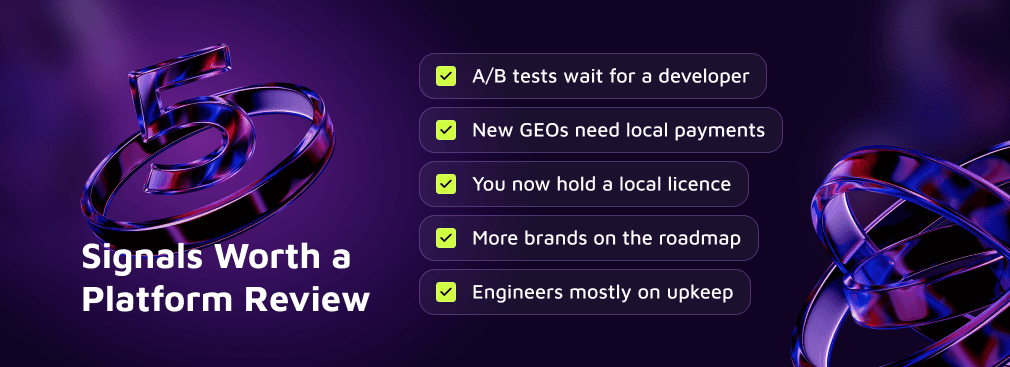
You now hold a local licence. White label runs under the provider’s master licence. Once you hold your own, turnkey becomes an option and the brand operates on regulated markets.
More brands are planned. The first question is how quickly the current stack can launch a new one. Some groups also spread brands across platforms to limit concentration risk.
These points go to your current iGaming software provider first, with a request for dates. When the gaps are in the core platform and no dates come back, it makes sense to compare the other routes.
The Decision Tree: 4 Questions for Year-Two Operators
The order of these questions matters. A clear yes on the first one means the other 3 can wait.
1. Does your current setup cover the next 12 months of your roadmap?
This one starts with your current iGaming software provider and the roadmap, item by item. What can it deliver, and by when? If the dates line up with your plan, staying usually wins. There’s no migration to plan, and your team keeps working in a back office it already knows.
Yes → Stay, with dates in writing. No → Question 2.
2. Is the gap in the core platform or in one module?
The core is the PAM and everything that depends on it, such as the wallet and the bonus engine. A gap there affects every brand on the iGaming platform.
A gap in a single module, such as CRM or game aggregation, is a smaller job. With a modular architecture, that module can often be replaced through API integration while everything else stays in place.
One module → Module swap, core stays. Core → Question 3.
3. Is owning the platform part of your strategy?
Some groups see their own platform as a long-term asset worth the investment. For them, a rebuild can make sense if the budget covers a permanent team for the core platform and compliance. If owning the stack isn’t the goal, licensing from an iGaming software provider frees your engineers for product work.
Yes → Rebuild, covered in the next section. No → Question 4.
4. Which licence do you hold?
Without a local licence, white label is the route. The brand runs under the provider’s master licence, and the jurisdictions on that licence vary from one B2B iGaming provider to another.
Operators that already hold a local licence can go turnkey. A turnkey iGaming platform runs the brand under the operator’s own licence, and the operator picks the modules it needs.
No local licence → White label. Own licence → Turnkey.
Rebuilding In-House: What the Budget Has to Cover
Building your own iGaming software gives full control over the roadmap. Your team also owns every part of the stack, along with every incident.
Is Building an In-House Platform Cheaper Than Licensing One?
A rebuild removes the platform fee and adds several other budget lines. You need engineers for the PAM and cashier, plus specialists for PSP integrations and market compliance. Game content needs its own contracts. Support and monitoring run 24/7, because players deposit at night too.
Technical debt adds one more line. Accenture’s 2024 research, based on 1,500 technology executives, recommends allocating about 15% of IT budgets to technical debt remediation. Skipping that work carries its own risk. McKinsey compared companies in the bottom and top 20% for tech debt. The bottom group was 40% more likely to see IT modernizations left incomplete or canceled.
Licensing fees show up on one invoice. The full iGaming software cost of an in-house team is spread across payroll and infrastructure, which makes it harder to see. Both need the same multi-year view. The total cost of ownership also covers the product work that waits while engineers keep the stack running.
Control is also available on licensed platforms. When your iGaming software provider lets the team configure bonuses and run A/B tests directly, much of the case for a rebuild falls away.
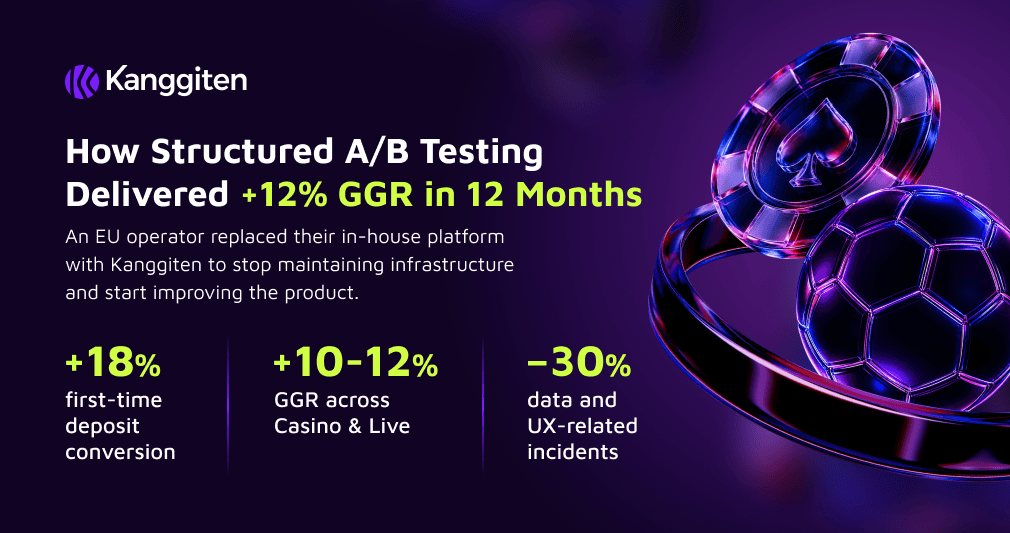
Case Study Snapshot: EU Operator (NDA)
Our client, an EU operator under NDA, launched on its own platform to avoid vendor lock-in and keep full control of the product. Over time, most of its small engineering team’s capacity went to maintenance and hotfixes. Payment integrations took weeks instead of days, and there was no testing framework. GGR stayed flat for 2 consecutive quarters.
After moving to Kanggiten, the team had tests running within the first month and completed 30+ structured A/B tests in year one. First-time deposit conversion went up 18%. Across Casino and Live, GGR grew by 10–12%, while data and UX-related incidents dropped by 30%.
Switching Providers: What a Migration Involves
A switch has a start date and an end date. The work in between decides whether players notice it.
How Long Does a Platform Migration Usually Take?
Timelines depend on scope. A standard iGaming platform migration to Kanggiten takes 7–21 business days of operational setup. Projects with custom work take longer. Our client Tier-1 Europe Casino, which moved from a self-built legacy platform, went live 2.5 months after contract signing.
The cutover window carries the main downtime risk. A solid migration plan fixes the cutover date with your iGaming software provider in advance and includes a tested rollback option. Kanggiten runs zero-downtime deployments, so releases after launch don’t interrupt play.
Can Player Balances and History Be Moved to a New Platform?
In a planned migration, they can. The work is in mapping each data set correctly and proving nothing was lost.
Player data transfer works best as its own workstream within the iGaming platform migration. These data sets need to move with each player:
- Real-money and bonus balances
- Transaction and game history
- KYC status and verification documents
- Active bonuses with wagering progress
- VIP tiers and loyalty points
- Responsible gambling limits and self-exclusion flags
Self-exclusion flags deserve a second look. If a player excluded themselves on the old platform, that exclusion has to hold on the new one from minute one. A missed flag is a compliance problem and real harm to the player.
Balances get the same treatment. At cutover, the team snapshots every balance and checks the imported totals against it. Players log in only after every gap is closed.
Then there’s the legal side. For EU players, the outgoing provider may act as a data processor. If it does, GDPR Article 28(3)(g) requires it to return or delete personal data when the service ends, at the operator’s choice. Format and timing of that handover belong in your contract, ideally before notice is given.
What Hidden Costs Come With Switching Providers?
Once listed, most of these costs are predictable. The harder part is deciding who carries each one, your team or your new iGaming software provider. That split goes into the contract.
Contract exit terms. With a 3-month notice period, you pay 2 providers until it runs out. Minimum terms can stretch that further. Both dates shape the migration plan.
Payment setup. Every PSP goes through onboarding and live testing again, market by market. That work is shorter when the methods already exist on the new platform. Kanggiten supports 300+ payment methods.
Game content. Game providers have to be set up again on the new platform. On Kanggiten, that means choosing from 200+ providers already in the catalog. Activation takes 48 hours per provider.
Team time. This one is easy to underestimate. CRM campaigns and affiliate tracking have to be rebuilt. Meanwhile, the team is learning a new interface and still running the brand.
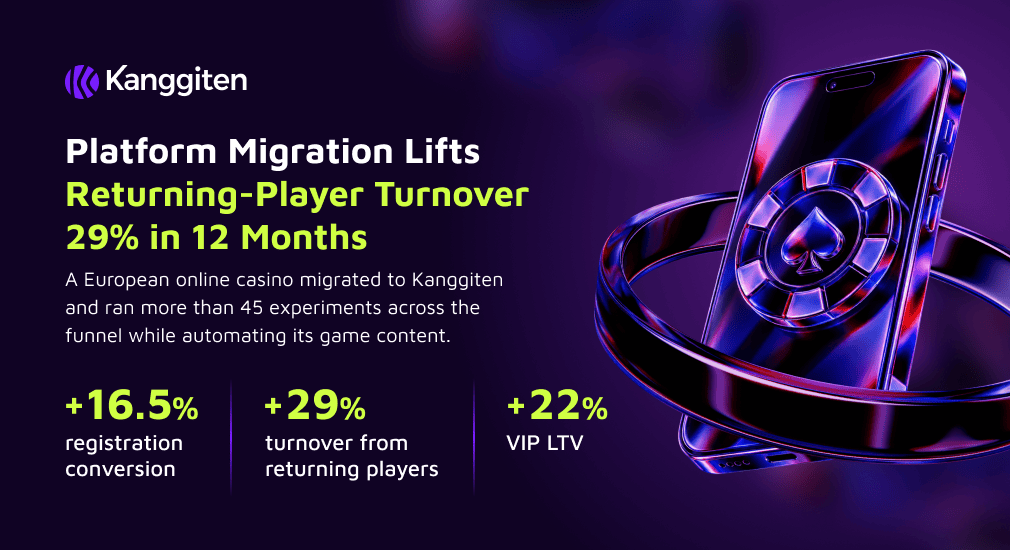
Case Study Snapshot: NDA Casino
NDA Casino, a Kanggiten’s client in Europe, had a stable product and growth plans that called for a faster release cycle. A/B testing was limited, and publishing a single game by hand took up to 72 hours.
After the migration, game publishing dropped to 15 minutes, and the team ran 45+ experiments in the first year. Registration conversion improved by 16.5%. Returning players brought in 29% more turnover, and VIP LTV was up 22%.
Choosing a Platform for the Next Stage
The best iGaming software for you depends on your licence and the markets on your roadmap. Plenty of providers run stable platforms. For a year-two operator, a useful test is whether the platform can carry the next stage of the plan without another move.
Kanggiten is an iGaming platform provider with 10+ years of B2C operations behind it and 50+ active brands on the platform.
Modular by design. Each product runs as a separate module, including InTarget CRM and FireAff affiliate tracking. Operators start with what they need and add modules or markets later on the same platform.
Testing built in. A/B tests run natively, from the registration form to the cashier. A typical one compares a 100% deposit bonus with a free spins package across 2 player segments. Your CRM team configures both offers itself. A developer only comes in for custom logic or a new mechanic.
Payment control. Operators configure PSP routing and withdrawal rules themselves, with 300+ payment methods available.
New brands on the same foundation. Multi-brand architecture lets operators launch another brand without rebuilding the setup each time.
Stable under load. The platform holds 99.9% uptime, and deployments run with zero downtime.
Each of these is worth testing in a live demo, with us or with any other iGaming software provider. The full module set is described on our best iGaming platform page.
“At Kanggiten, our platform is built from independent modules that communicate either through a shared data channel or via APIs. This ensures that if one module, like a tournament or bonus engine, gets overloaded, it does not bring down the entire platform; core functions like payments remain fully operational.”
Ivan Korkin, Head of Account Management at Kanggiten
Case Study Snapshot: Tier-1 Europe Casino
Before they chose Kanggiten as an iGaming software provider, our client Tier-1 Europe Casino ran its own legacy platform. That stack had no native A/B testing and a limited bonus toolkit, and some major game providers were missing from the lobby.
On Kanggiten, the team ran 50 A/B experiments across 5 funnel stages and added 26 game providers. GGR grew 36% across all markets within 12 months. Over the same period, LTV rose 18% and ARPU 26%.
A 90-Day Path From Review to Decision
Days 1–30: map the gap. The first month produces a list of what the roadmap needs from the platform over the next 12 months. Each item is marked as covered or open. Payment approval rates by GEO and engineering time spent on maintenance belong in the same review.
Days 31–60: ask and compare. Your current vendor gets the roadmap and a request for dates. In parallel, each iGaming software provider on your shortlist runs a live demo. Legal reviews the exit clauses in your current contract.
Days 61–90: decide and plan. With the answers in hand, the decision tree points to a route. A switch then needs an iGaming platform migration plan with a fixed cutover date and a tested rollback option.
When we asked our CEO, Viktor Cherkas, what operators most often underestimate in retention, he named execution speed. In his view, most teams already know what they should be doing.
“The difference is how quickly they can turn an idea into a live test and then scale it if it works.”
If a second opinion would help, the Kanggiten team can go through your roadmap with you. You’ll get back a personalized migration plan, with pricing.