



You already have the traffic, or the capital to put behind a brand. What’s still open is the platform it all runs on. That choice sets your launch speed and your ceiling on conversion. It also decides which markets you can legally reach.
None of that shows in a demo. Every platform looks capable until real traffic hits it. Then the failure modes surface. A player account system wobbles when traffic spikes. A launch sold in weeks slips into quarters. Conversion flattens and stops responding to anything you try. Smaller cuts follow. A key payment method is missing in your best geo. Support sends a ticket number when you need a person.
The model you pick determines how many of those you inherit. Starting on borrowed infrastructure removes a good share of them from day one. A white label casino platform puts your brand on a provider’s license and technology. It stays the fastest route to a live operation.
This guide ranks 9 iGaming white label solutions and shows how to match one to your situation. No hype. Just the tradeoffs and the numbers that separate them.
Key Takeaways
- The license sets your map before anything else does. A white label runs on the provider’s license, which is what makes it quick to launch, and it leaves markets that demand a local license out of reach.
- Conversion is a property of the platform, not only the CRM team. A provider that has run its own brands knows which funnel decisions move the number, because it holds the data behind them.
- Modularity is insurance against the next migration. Platforms that add markets and features without a rebuild spare you the move that costs the most.
- Fit beats reputation. An affiliate team going independent weighs different things than a fund entering a regulated market, so the strongest name on paper is not always the right one.
- Support shows its real shape on your worst day. A named contact and a reachable team matter more than the feature list when something breaks at 2 a.m.
Market Size Is the Easy Part
The demand is not in question. Statista projects global gambling revenue near $655bn in 2026, with online formats past $123bn of that. Europe is the largest online region.
That headline hides the part that decides a launch. Europe splits into national markets. Germany, Austria, Greece, and Romania rank among the largest, and each one gates access by license.
So the size figure shows the opportunity. It does not show the route in. A provider’s master license opens a broad set of markets fast, which is what makes a white label quick to go live. Regulated markets fall outside that license. Reaching them legally means holding your own. The field of B2B white label iGaming solutions has consolidated around a manageable shortlist, and the ranking below covers it. Keep the license split in mind as you read, because it decides which providers fit your markets.
What Is a White Label Casino Solution?
A white label puts your brand on top of a platform that already exists. The provider owns the technology, the core license, and the plumbing. You own the brand, the marketing, and the relationship with players.
Underneath, three parts do the work. Player account management (PAM) holds accounts, wallets, and the player lifecycle. A back office runs bonuses, reporting, and daily operations. The best white label iGaming software solutions put the promotion and segmentation controls in the operator’s hands, so campaigns are configured without a developer in the loop. API integration wires in content and payments, so a games aggregator and your payment providers connect through one layer rather than a dozen separate builds. Together they form the closest thing to a ready-made online casino platform, which is why operators reach for this model when speed is the priority.
Most white label iGaming solutions ship with that stack preassembled. The differences that matter show up later, in how well each part holds under load and how much control the back office hands you.
What Is the Difference Between White Label and Turnkey Casino Solutions?
Whose license you run on. That is the whole difference.
A white label uses the provider’s license, so you launch fast and hand over some operational control in exchange. A turnkey online casino runs on a license you hold yourself. It takes longer to stand up and costs more at the start. But it gives you full ownership plus the only legal way into markets that require local licensing.
The companion piece on white label vs turnkey casino solutions breaks the tradeoff down further. For this ranking, the rule is simpler. If your target markets accept a master license, a white label gets you live sooner. If they demand a local one, turnkey is the route.
The 9 Best iGaming White Label Solutions in 2026
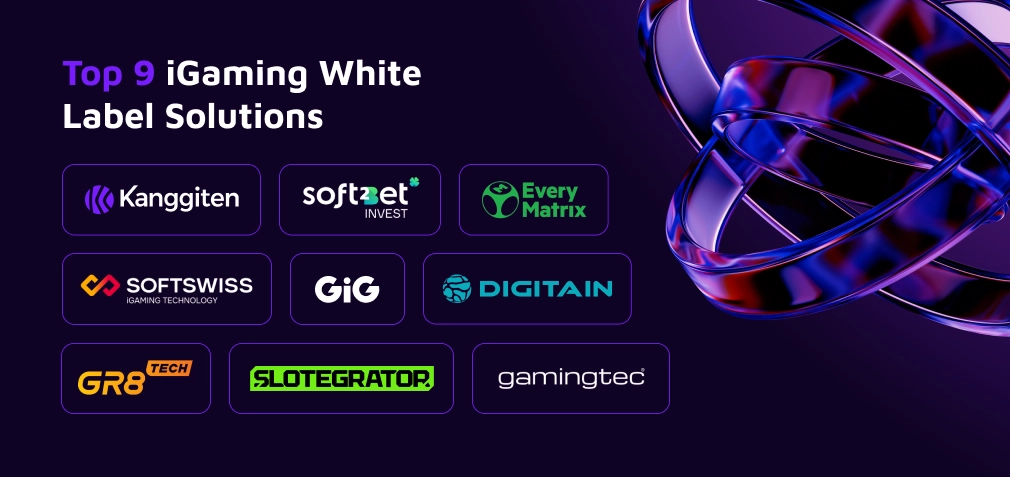
The ranking weighs the factors that change results once an operator goes live. Platform stability under real load ranks first. Conversion has to be backed by data, not claims. Payment and geo coverage decides which markets you can serve. Support and commercial transparency round it out. Game breadth matters too, though most providers clear that bar now.
All nine of these iGaming white label solutions are established platforms with live operators behind them. The order reflects how well each fits an operator building or moving a casino brand, with the sportsbook-led names weighted for the sport-first buyer.
1. Kanggiten
Kanggiten was built by a team that ran its own B2C casinos for a decade before turning the stack into a product. The funnels and the conversion data came from running live brands, not from a spec sheet.
The platform now carries 50+ active brands and holds 99.9% uptime. Its catalog runs past 20,000 games, and payments cover more than 300 methods in over 100 countries, with multi currency support. Registration to deposit reaches up to 70%. Retention runs up to 39%. Both figures move with geo and traffic source. Going live takes 7 to 21 business days, and a major deployment lands inside 1 to 3.
Modularity is the design choice underneath. An operator launches with a casino and adds a sportsbook or CRM whenever the business needs one, and a new market opens without a migration. Gamification is built in. Its tournaments, prize wheels, leaderboards, and reward mechanics all tie back to the bonus engine, and each promotion ships with caps and anti-abuse rules from its first save. Testing never stops. A/B experiments run across the funnel and cut the dead steps out of registration and deposit.
Support is a named account manager and a 24/7 team rather than a ticket queue. The white label runs on a master license in Curaçao, Anjouan, and Tobique. For operators that want B2C-grade conversion tooling without owning the stack, that is the case Kanggiten is built for.
2. SOFTSWISS
SOFTSWISS opened in 2009 and works out of Malta. Its 2026 has centered on regulated markets. April brought a new Prediction Markets platform, and the company kept expanding across North and Latin America. Crypto came first, though. Native multi-coin wallets have been in place since 2013, which keeps SOFTSWISS on the shortlist for crypto-forward brands.
The product line is broad. A casino platform and turnkey builds run beside a Game Aggregator carrying 40,000-plus titles, a sportsbook with shared network-jackpot campaigns, the Affilka affiliate system, and a Jackpot Aggregator. More than 1,000 brands run on the stack, which makes it one of the larger houses in the category. Pricing lands at the premium end, so an early call is best treated as a scoping exercise.
3. Soft2Bet
Soft2Bet’s core product is MEGA, a gamification engine that layers missions, levels, and rewards across the player journey. Through 2026 it grew from a bonus tool into a wider retention system, and it took two EGR Europe awards plus Industry Innovation of the Year for North America at the SBC Awards Americas.
Founded in Malta in 2016, the group builds its core stack in house and brings casino, sportsbook, CRM, payments, KYC, and risk into one operating setup, offered as turnkey, white label, or single modules. Recent launches include the Zinx platform in Romania and a new brand in Denmark, alongside a licensing move into Ontario. For a brand betting on engagement mechanics to carry growth, it warrants a look, with reference checks weighed accordingly.
4. EveryMatrix
EveryMatrix has scaled from a white-label sportsbook startup in 2008 into a tier-1 enterprise supplier, and is now among stable B2B white label iGaming solutions. Its recent growth has come from regulated markets. The company holds regulated North American licenses covering Ontario plus US states New Jersey, Michigan, West Virginia, Connecticut, and Pennsylvania, with content deals at operators such as Caesars and DraftKings. More than 300 clients run on its systems.
The architecture stays modular, split into SlotMatrix for casino content, OddsMatrix for sport, GamMatrix for player management, MoneyMatrix for payments, and PartnerMatrix for affiliates. A run of studio deals, taking in Spearhead, Armadillo, and Fantasma, added in-house game production on top of an aggregator spanning tens of thousands of titles. The scale suits operators chasing regulated reach, though it positions and prices above the lightweight end of the market.
5. GiG
GiG changed shape in 2024. The old Gaming Innovation Group split in two. The platform-and-sportsbook side kept the name as GiG Software, and the affiliate arm left as Gentoo Media. One earlier decision matters more for buyers. Back in 2020, GiG sold its consumer brands to Betsson. It holds no casino of its own now, so a client never has to wonder whether the platform partner is also a rival in its market.
The product splits cleanly. The platform and player management run through GiG Core. GiG Sports covers the book, strengthened by the Sportnco acquisition. On credentials, the company holds ISO 27001 and has launched in regulated US states. GiG suits an operator after tier-1 infrastructure and a clean B2B stance, with a partner already tested in regulated markets.
6. Digitain
Digitain is a sport-first supplier out of Armenia, more than twenty years in the market. Regulation defined its 2026. UK Gambling Commission certification came through, along with manufacturer licenses in Bulgaria and fresh approvals in Belgium, Denmark, Ontario, and South Africa. Africa is where it is pushing hardest, with new activity in Malawi, Zambia, and Kenya. On the commercial side, a chief commercial officer arrived from Sportradar to run Europe and Africa.
The book is the strongest asset, backed by an in-house trading and risk team of more than 1,300, with the Centrivo platform, a payment gateway, and virtual sports rounding out the offer. Casino content comes through aggregation and reads as secondary to sport, which is the honest framing for a gaming-led brand. Brand ambassadors Luís Figo and Alessandro Del Piero front the marketing, and 2026 recognition included Best Supplier at the European iGaming Awards. It suits operators whose growth plan is built on betting first.
7. GR8 Tech
GR8 Tech is a Cyprus-based white label iGaming software solutions provider built around its sportsbook. Its ULTIM8 Sportsbook anchors the lineup, and much of 2026 went into readying it for World Cup traffic, with a redesigned front end, expanded Bet Builder markets, and AI-driven betting limits. A newer Managed Trading Services product lets operators keep their own front end while handing odds, trading, and risk to the GR8 team, which widens its reach beyond full-platform clients.
The wider stack pairs Crypto Turnkey and Hyper Turnkey builds with Infinite Casino Aggregation and the Aff.Tech affiliate tool, all engineered to hold under peak load. The company counts more than 100 operator cases. It fits an operator expecting heavy betting traffic and wanting the sportsbook to carry the brand.
8. Slotegrator
Slotegrator has built turnkey and white-label casinos since 2012. Aggregation is the core. Its flagship, APIgrator, opens 30,000-plus certified games from 180-plus studios through a single integration. Three more products round out the stack. Moneygrator runs payments, Sportegrator adds a sportsbook, and Casino Builder covers the front end. Licensing help comes with it, across Curaçao, Anjouan, Malta, the Isle of Man, and Kahnawake. Most launches land in a published 30-to-45-day window.
The market focus is emerging regions, with real strength in Asia, the CIS, and Latin America and broad local-payment coverage. The tradeoffs follow from that positioning. The catalogue is smaller than the largest aggregators, the licensing leans offshore rather than tier-one, and the affiliate module is built to be adequate. For a mid-market operator in developing markets, it is a practical, quick-to-launch option.
9. Gamingtec
Gamingtec is a B2B iGaming software provider that has run since 2013. It supplies turnkey casino and sportsbook platforms along with game aggregation, affiliate software, agent systems, payment processing, and player management. Both white label and turnkey routes are on offer, with a quick-launch platform at the core.
Agent systems set it apart for operators working retail-style or agent-driven models common in parts of Asia and Latin America. The company picked up Best iGaming Platform Provider Europe 2026 from Brands Review Magazine. For an operator that wants a broad casino-and-sportsbook build with agent tooling included, Gamingtec is worth a shortlist slot.
How Do You Start a White Label iGaming Business?
Launching on white label iGaming solutions follows a consistent path, whatever provider you pick. Start with the map before the platform. The markets you intend to serve decide your license route, and that route rules some providers in and others out. A master-license setup covers a wide spread of markets fast. A regulated target means a local license and a turnkey build.
From there, the path runs in a few clear stages. Shortlist providers against your profile and your markets. Scope the commercials early, including setup fees, revenue share or monthly minimums, content and aggregator costs, and payment processing. Line up your payment gateways for each geo, since approval rates and local methods make or break the cashier. Get KYC and AML flows right for every market you enter. Then launch, and treat the funnel as something you keep testing rather than a thing you set once.
Time to market is where the providers separate. Some quote weeks, others quote months, and the honest number depends on your content, your payment integrations, and how ready your brand assets are on day one.
Which White Label Casino Platform Is Best for a New Operator?
There is no single winner among iGaming white label solutions, only a best fit for how you operate. A new operator should read the list through its own profile.
An affiliate or arbitrage team going independent already has traffic, so it should weight launch speed and conversion tooling. Kanggiten speaks directly to that buyer. An operator migrating off a limited platform should put stability and a clean migration path first, which favors the modular platforms that add scope without a rebuild. A fund or new-market entrant should study the license route and the depth of support, since the first launch sets the template for everything after. And if the business runs on sport, the sportsbook-led names deserve the closest look, because a deep book and strong live dealer games coverage matter more to that buyer than to most.
One more filter helps a first-timer. A white label gaming platform is only as good as the control its back office hands you, so ask to see the bonus, segmentation, and reporting screens before you sign, not after.
The Shortlist That Ages Well
The iGaming white label solutions that hold up over the next few years are the ones that adapt without a rebuild. Three shifts are already redrawing the field. AI-driven personalization is turning from a differentiator into a default. Crypto rails are maturing into standard payment options. Regulated markets keep raising the bar on licensing and compliance. For operators comparing B2B white label iGaming solutions today, those shifts should shape the shortlist more than any single feature does.
The names above are split cleanly by the buyer. A crypto-first operator, a sport-led brand, an affiliate team going independent, and a fund entering a regulated market will each land on a different name among these casino software providers. The strongest iGaming white label solutions treat compliance, payments, and retention as moving targets rather than fixed features.
For an operator ready to pressure-test a shortlist, Kanggiten offers a walkthrough of its platform and migration path on request, with the conversion and retention data behind the numbers open for review.
FAQ
How Much Does a White Label Casino Cost?
There is no single figure, and any provider that quotes one without asking questions is guessing. Expect a setup fee, then either a revenue share model or a monthly minimum, plus content and aggregator costs and payment processing fees. What moves the total is your market mix, the payment methods you need, and the level of support you want. Ask for a full cost breakdown before signing, not a headline rate.
What Licenses Come With a White Label Casino Solution?
A white label runs on the provider’s master license, usually held in Curaçao, Anjouan, or Tobique. One setup covers a broad set of markets. It does not cover markets that require a local gaming license. Serving players there legally means holding your own, which points toward a turnkey build.
How Long Does a White Label Casino Take to Launch?
Across the field, launches run from a few weeks to a couple of months, depending on the provider and the scope. Kanggiten reports operational setup of 7 to 21 business days and major platform deployments of 1 to 3. The variables are content selection, payment integrations, and how ready the brand assets are on day one.